Code Generation
In brief
spec:buildreads the contract and writesroutes.phpplus one controller per operation, each answering 501 until somebody implements it.- A build never destroys your work: generated code and your code never share a file, so it is always safe to re-run.
- Nothing opens a specification while the application runs. The provider loads one generated file and knows nothing about where it came from.
- Your classes extend the generated ones, so a change to the contract becomes a static analysis error instead of a surprise in production.
- Not built yet: response DTOs, request validation, and the sanitized public copy.
Spec-First only pays off if the contract reaches the code. This document owns how it gets there: one build command turns the specification into PHP, and the result is safe to regenerate at any time. It carries what the rest of the subject rests on, and the build command itself; the four files beside it answer one question each, and are linked from wherever that question comes up.
Almost all of this is intent rather than behaviour, and like
openapi-support.mdthis file marks the difference per section rather than per file, so the banner does not become a little more wrong with every release. Items markedOpenare undecided.Shipped:
spec:buildin its Phase 1 form, which resolves the specification and emits the routes and one controller per operation, each carrying its own docblock and answering 501. It is idempotent, it plans before it writes, and it never writes outside its own tree. The provider loads what it emitted and reads no specification to do it. Thex-controllerseam is shipped, so an operation that declares one gets a parent it may extend and a route pointing at the child, andspec:makescaffolds that child. Not built yet: response DTOs and request validation. Rename detection was designed here and decided against.
What the build reads, and what it refuses to read, is a different subject and lives in openapi-support.md.
A build never destroys your work
Every rule below exists to serve one property. You can run the build at any moment, on any machine, as many times as you like, and nothing a developer wrote is lost. A code generator you are afraid to re-run is a code generator that stops being run, and a Spec-First package whose generator stops being run has quietly become Code-First again.
The invariant is structural, not a matter of care. It holds because generated files and human-authored files are disjoint sets, different files in different places. The build owns its files completely and never opens the others.
Why there is no exception clause
An earlier draft let the build create a starter class when one was missing, which sounded harmless and was not: "the build never writes a file it does not own, except when it does" is a rule that erodes, and every later feature would have argued for its own carve-out. Creating a class a human will own is a different command's job.
The runtime never sees the spec
The service provider does not know a specification exists. Only the build-time commands read one. At boot, the package loads generated PHP and nothing else: no YAML, no parser, no resolution, no $ref.
Explicit over dynamic, everywhere. The alternative, a provider that parses the contract on every boot, was never really compatible with the rest of this document, and saying so plainly is cheaper than discovering it halfway through the implementation.
What follows from it:
- The parser is a build-time dependency in practice.
cebe\openapi\classes must never be reachable from the routing or request path. This is not a convention to remember: the architecture test contains the parser to one namespace, which forbids it to the request path and to everything else at once. The assertion was written before anything imported the parser and is binding now thatOperationExtractordoes. - Boot cost is loading PHP, which is what
route:cacheand the opcode cache already optimize. No work to memoize, no cache of our own to invent. - The boundary is the production request path, not the process. Serving a real application's traffic never involves a specification. Other contexts plausibly do, and pretending otherwise now would only mean rewriting this section later: contract testing has to compare a live response against the contract, and a mock server is a spec-driven server by definition. Those are separate execution contexts with their own rules. Deferred deliberately: the contexts get enumerated when the first one is built, not guessed at now. Nothing about containing the parser to
Parsing\blocks them: a mock server reads a contract through the same door as everything else. - It creates one new failure mode, and it must be named: edit the spec, forget to build, and the application serves the previous contract without a word, because nothing at runtime knows a spec exists to compare against. Detecting that drift is the doctor's job, which makes it a required CI check rather than a convenience. A package this strict about contracts cannot ship the one silent way to be out of date.
Three kinds of file
Two of them are the build's, and the third is yours:
| Kind | Lifecycle | Who owns it |
|---|---|---|
| Generated | Rewritten from scratch on every build. | The package. Never edit it: your edit is gone on the next run, by design. |
| Vendored inputs | Never fetched unless asked; frozen by default. | Upstream. See remote references. |
| Your classes | Created once by spec:make, on request. The build never touches them. | You, entirely, from the moment the file exists. |
The generated kind should be unmistakable at a glance and at grep-time: its own directory, its own namespace, and a header on every file saying it is generated and will be overwritten. A developer should never have to wonder which side of the line a file is on, and neither should an AI agent working in the repository, which is a first-class consideration for this package.
The marker names the build's output
Every generated file carries the same line, @generated by lara-spec-first, and it is load-bearing rather than decoration. It is the one thing that tells the build which files are its to delete.
That matters because "rewritten from scratch" has to mean the tree matches the contract rather than accumulating what the contract used to say. A controller for an operation the specification no longer has is pruned, or the generated tree slowly fills with classes nothing routes to. Pruning is therefore a deletion the build performs on its own, which is exactly the act the invariant exists to bound, and the marker is what bounds it. Only a file carrying it is ever removed, so a file somebody wrote inside the generated tree survives a build even though it should not be there.
One exception, stated rather than left to be discovered: an empty directory inside the tree is removed whoever created it. A directory carries no marker, so there is no way to tell one the build made from one a person did, and leaving Controllers/ behind after its last controller was pruned reads as a bug. Nothing that holds a file is touched, which is the part that matters.
Its value is public API surface, and for a reason worth naming: changing it orphans every tree an earlier version wrote, and nothing will ever prune those files again. It is named in the freeze list a 1.0 owes its consumers for that reason, alongside the generated tree's layout.
The split makes a change loud
The mechanism is ordinary PHP, and that is the point: generated abstract classes and interfaces, extended by human-written concrete classes.
Say an operation gains a required parameter. The build rewrites the generated abstract, whose method signature changes. Every concrete subclass a developer wrote now fails to satisfy its parent, and PHP, plus PHPStan at level 8, says so immediately, by name, before anything runs.
That is the whole payoff of Spec-First expressed in one behavior: a change to the contract becomes a compile-time error in the code that implements it, not a 500 in production. It is also why the generated side must be free to change shape without asking permission. It can only be free if nobody has hand-edits in it to protect.
The build command: spec:build
Everything derived from the contract comes out of one command, whose flags and exit codes are in the command reference:
php artisan spec:buildOne command, run after any change to the specification, producing every derived output: the routes, the abstract controllers, the response DTOs and the validation. Everything it writes, it owns.
Shipped, in the form Phase 1 asked for. It reads the document named by lara-spec-first.spec.path, extracts the contract's operations, plans every file in memory, and writes. Which specification it reads is one root document rather than a list: multi-file contracts are written as local $refs from it, and a list of roots would raise questions nothing has settled: whose order wins, and whether each gets its own generated tree. Widening it later is non-breaking.
The two steps are the design rather than structure for its own sake. A build that emitted as it went would leave a half-generated tree behind the first operation it could not handle, and half-generated output from a broken contract is worse than no output: it analyses, it autocompletes, and it lies. Planning first means a refusal costs nothing, and the working tree is exactly as it was.
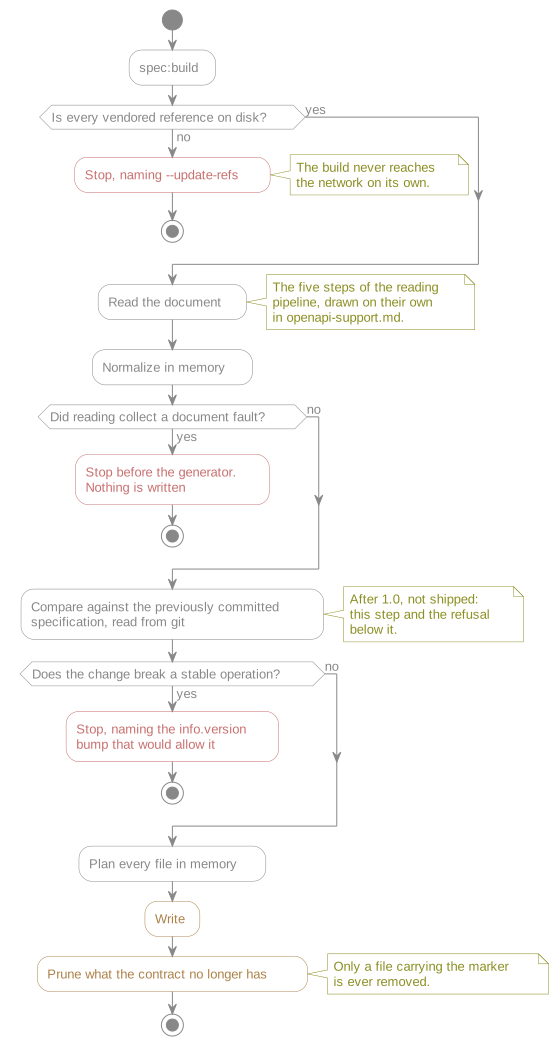
The ordered steps of a build. Three of them can refuse, and nothing is written before the last one.
The order, with its refusals drawn where they sit. The picture also places the reading pipeline where it belongs: one step of a build rather than the whole of it, which is the relationship a reader arriving on either page has had to assemble for themselves.
Its properties:
- Idempotent. Running it twice in a row changes nothing the second time. If a build produces a diff on an unchanged spec, that is a defect. A formatter counts as part of that promise, which is why it gets its own section.
- Ordered, and it stops. Check the vendored references are present, parse, normalize in memory, compare against the specification's previously committed version, read from git, then generate. A spec that fails the doctor's hard checks does not reach the generator, because half-generated output from a broken contract is worse than no output. The comparison sits before generation for the same reason: nothing is written until it is known to be allowed. See the baseline for what "previously committed" means and why it depends on git history rather than a file the build writes.
- It never writes outside its own directories. No exceptions, no conditions. This is the invariant in one sentence, and it is testable, which is the point of stating it without a clause.
Your formatter fights the build
Shipped, and learned the hard way rather than designed.
Idempotence is a property of the pair, not of the build alone. Almost every Laravel project formats its code, and a formatter rewriting a generated file is a formatter the next build undoes, so the two rewrite each other forever, a git status is never clean, and the promise above quietly stops being true. It is not hypothetical: this package's own Workbench application caught exactly this, because Pint's Laravel preset inserts a blank line before an annotation (phpdoc_separation) and the generated docblock did not have one. No test saw it, because the tests wrote to a temporary directory where no formatter was looking.
There are two halves to the answer, and only one of them is ours.
Ours: the build emits the canonical form. What it writes is what Pint's laravel preset would have produced, and the test suite runs Pint over the generated output to keep it that way. A project on the default preset needs to do nothing at all.
Yours: exclude the generated tree from your formatter anyway. We can be canonical under one rule set, not under every rule set, since a project on psr12, on symfony, or with rules of its own will disagree with us somewhere, and it should win in its own codebase without a fight. In pint.json:
{
    "preset": "laravel",
    "exclude": ["app/Http/Generated"]
}
exclude takes directories; notPath takes single files, and notName takes filename patterns. php-cs-fixer has the same shape through its own Finder. One detail worth knowing, because a pipeline can lose it: exclude applies to the default scan, not to a path passed explicitly: pint app/Http/Generated still formats the tree, so a CI step that names paths has to leave it out itself.
And there is nothing lost by excluding it. These files are rewritten from scratch on every build, so formatting them is work with no product: the result is discarded the next time the specification changes.
A specification is untrusted data
Shipped, and it was found by a review rather than by design.
Every value the build takes from the document crosses a boundary, and that boundary is where injection lives. A path template, an operationId, an x-sunset: all of them are free text as far as OpenAPI is concerned, and all of them end up inside PHP the application loads. Two rules, because there are two kinds of destination:
- Into a string literal, always through
var_export(). OpenAPI puts almost no constraint on a literal path segment, so/users/o'brienis a valid contract, and a hand-quoted literal built from it is PHP that does not parse. A trailing backslash breaks it a character later, by escaping the closing quote. - Into a comment, always neutralized first. A value that closes a block comment does not merely break the file, and this is the part worth reading twice: the docblock ends early, whatever follows becomes a statement, and the docblock's own closing delimiter reopens and closes a comment around the rest. The file parses, loads and executes. Verified rather than argued: an
x-sunsetcarrying that sequence produced a controller that ran code when autoloaded.
The severity comes from where the output lands. routes.php is loaded at boot, so a broken one takes down every request and every Artisan command, including the spec:build that would repair it, and the only way out is deleting the tree by hand. And a specification is exactly the document nobody reviews like code: it can arrive from another team, a vendor, or a generator.
It contradicted this document's own invariant, which is the part to learn from. The build promises that a contract it cannot serve leaves the tree untouched rather than half generated. Here the contract was not refused: it was accepted, and the output lied. Escaping rather than refusing is nonetheless the right answer, because an apostrophe in a path is something this package can honor, and Rejected is reserved for what it cannot.
And the guard already existed. A test runs php -l over everything emitted; what was missing was a contract written to attack it. That is the general lesson rather than a detail of this bug: a test covers the inputs somebody thought to write down, so the fixture is now adversarial by design and every new emitted construct earns a hostile case in it.
Native calls, not a Storage disk
Shipped. It looks wrong in a Laravel package, so it is worth stating why it is not.
There are two filesystems in Laravel and conflating them is the whole trap. Storage, backed by Flysystem, is for application data whose location is a deployment concern: an upload, an export, something that may live on S3 tomorrow. Illuminate\Filesystem\Filesystem is a thin wrapper over the native functions, and it is what every make: command in the framework uses to write a class. "Disks are the norm" is true of the first and not of the second.
The rule that decides it: is where this file goes a deployment concern, or a language one? Generated PHP has to be on the local filesystem at a path PSR-4 maps to a namespace, or nothing can load it. A disk would let a project point it at S3 and produce files that autoload from nowhere, a setting whose only outcome is a broken application.
And this package answers the same question the other way where the other way is right, which is the best evidence the rule is doing work rather than rationalizing: the sanitized public specification is configured as a disk, because that document is served, and whether it is served from local storage, S3 or a CDN is exactly the kind of thing a deployment decides. One rule, two answers, no inconsistency.
Native calls rather than Illuminate\Filesystem\Filesystem is then a smaller choice, and deliberate on two grounds: GeneratedTree stays a plain object a unit test can build with no container, the pattern this package already follows for its guards; and the wrapper would fix nothing, since its put() also reports failure by returning false.
The umask decides the mode
mkdir is called with 0777, and the umask decides, not that number: the process umask is subtracted from it, so a normal 022 yields 0755 and a shared-group 002 yields 0775. Passing the permissive value defers the policy to the operator instead of overriding it, and it is exactly what the framework's own generators pass: GeneratorCommand::makeDirectory() calls makeDirectory($path, 0777, true, true) for every make: command. Nothing is ever chmod-ed afterwards, for the same reason: forcing a mode would override the policy this defers to.
What actually needed fixing was not the mode but the silence. The scenario a container makes ordinary is that the build runs as one user and the tree belongs to another, root inside Docker or a deploy step. PHP reports that by returning false and emitting a warning, so a build that ignored the return value counted a file as written that was never on disk, reported success and exited zero. Every write is now checked, and an unwritable tree stops the build with a message naming the path. A refusal leaves the tree exactly as it was, which is the same promise the planner makes one step earlier.
The friction worth naming rather than solving: if a build has run as another user, the developer on the host cannot overwrite the result. That is a property of any generator in a container, and the answer is the one this repository already uses for itself: map the host UID and GID into the container, as compose.yaml does. It is not something a package can fix from the inside, and inventing a permission strategy here would only add a second policy to disagree with the operator's.
The build is frozen by default
The build never reaches the network unless asked. A missing vendored document is an error that names the flag to run, not an excuse to open a socket.
This is a deliberate reversal of the earlier "fetch whatever is missing" default. That default was convenient, and convenience is the wrong tiebreaker for the one operation that can change an API contract without anyone deciding to. Under a frozen default:
- A fresh clone builds offline, because every vendored copy is committed.
- Adding a new
$refto the spec fails the build once, with a message saying exactly what to run. One deliberate command, and the new document lands in the next commit as a reviewable diff. - A missing vendored copy in CI or production means somebody forgot to commit it, and the pipeline says so instead of papering over it with a fetch.
- There is no environment-dependent behavior to reason about. The build does the same thing on a laptop and in CI, which is the property that makes a build trustworthy.
Fetching therefore has one entry point in build: --update-refs, matching the install/update vocabulary the dependency framing already borrows. One flag for both cases, adding a reference that is missing and refreshing one already vendored, rather than two: simpler, and the consequence either way is the same command to run again.
None of which should make designing an API tedious. That is what watch mode is for, and it is a different command precisely so that build can stay this strict.
Which generated code is committed
Ignore the generated tree, the way you ignore vendor/.
# .gitignore: the generated tree is build output.
app/Http/Generated/
It is build output. An idempotent build reproduces it byte for byte, so tracking it buys a diff nobody reviews and costs a conflict on every contract change. Two lines make it work: that one, and php artisan spec:build in your deploy beside composer install.
The cost is the composer install bargain, and it is the reason this is a recommendation rather than a rule: a fresh clone does not analyse, autocomplete or run until the build has been run once. Committing the tree instead is a defensible answer, and the project that cannot add a build step to its deploy should take it.
The mechanism stays .gitignore, and there will never be a config key for it. Git is already every consumer's answer to "I do not want this in my repository", and a config option here would be inventing a second, worse .gitignore.
One exception, and it is not optional: the vendored references must be committed. There is no lock file: the committed copies are the lock. Ignoring that directory does not save you noise, it removes the only mechanism that makes a build reproducible and an old release deployable. The doctor should detect it and report it as a finding rather than let it be discovered during an incident.
An interface and an abstract class
The build emits an interface plus an abstract class, splitting the output along the line that matters:
| Layer | Carries | Worth committing |
|---|---|---|
| Interface | The contract surface: method signatures, DTO shapes, the things a change to the spec actually changes. | Arguably, because this is the diff a reviewer wants, and it is small. |
| Abstract class | The mechanics that implement the interface. Predictable, derivable, and noisy in a diff. | No, since an idempotent build reproduces it exactly. |
It fits the split rather than complicating it: the interface is what a human subclass is checked against, so the compile-time error survives even if the abstract layer never enters version control.
This is the one thing that could make committing part of the tree worth the trouble, and it is why the recommendation above is written about the tree rather than about each file in it. Until the split exists there is one directory and one line; once it does, a project that wants the contract surface under review can track the interface and ignore the rest. Still .gitignore deciding, still not a config key.
Open: whether the second layer is an abstract class or a trait. An abstract class gives one inheritance slot to the developer and takes it; a trait leaves it free and composes, at the cost of not being able to declare abstract members quite as directly. It is a question best settled against real generated output.
And it no longer applies to DTOs, which is a reversal worth naming. An earlier version of this document made response DTOs the canonical example of this split: a generated abstract declaring the shape, a human subclass overriding from(). DTOs are now final readonly and their customization lives in a factory instead, because a value object mirroring the contract has no behavior of its own to extend. The two layers still describe the controller seam; they no longer describe DTOs. Said plainly so that a reader coming from the old version reads a changed position rather than a contradiction.
Where generated code lives
One config key decides, defaulting to app/Http/Generated and the namespace App\Http\Generated.
Under app/ because it is application code the developer will read, extend and debug, not a build artefact hidden in bootstrap/. Under app/Http/ because that is where Laravel already puts controllers, form requests and middleware. Everything generated here is HTTP-layer machinery, and it belongs beside the concrete controllers that extend it rather than in a directory of its own invention. Configurable because no default survives contact with every project.
The name has a job. It appears in every use statement, every stack trace and every IDE autocomplete for the lifetime of the project, so it should say do not edit this without anyone having to look it up. Generated does that in one word; a name like Integration says nothing about ownership, which is the only thing a reader needs from it at a glance.
One configurable root, with fixed sub-namespaces beneath it, Controllers, Data and whatever follows, rather than a separate config key per kind of output. A team that keeps its DTOs in App\Data will notice the difference, and it is a small one: these are files nobody may edit, so where they sit matters far less than for hand-written code. What one root buys is worth more:
.gitignoreis one line. The mechanism we chose works by directory, so a split tree means several entries, and a consumer who forgets one ends up with half a generated tree committed and half not.- "Everything under here is generated" is only a rule while there is one here.
- Widening later is a minor release, narrowing is a major one — the same reasoning
stack.mdapplies to version support. If per-kind overrides turn out to be wanted, they can be added without breaking anyone; starting with them and removing them cannot.
Two details that will otherwise be discovered the hard way:
- PSR-4 requires the directory segment and the namespace segment to match, including case. A standard Laravel application maps
App\toapp/, soapp/http/generatedautoloads asApp\http\generated: legal PHP, and an immediate source of confusion. Every segment is capitalised in the default for that reason. - Path and namespace are two settings, not one. Deriving one from the other means guessing at the consumer's autoload map. Both are configured, and the doctor checks they agree with what
composeractually autoloads, and a mismatch there produces class-not-found errors far from their cause.
The config key names and the default are public API surface under rule 4.
The routes are one file
Shipped. spec:build writes it, Routing\GeneratedRoutesLocator locates it, and the service provider loads it at boot.
Route registrations go in a single routes.php at the root of the generated tree, beside the sub-namespaces rather than inside one. It is the only generated file the runtime ever opens, and it is a script rather than a class: PSR-4 has nothing to say about it, and the provider reaches it through Laravel's own loadRoutesFrom(), which is what skips the file when the application's routes are already cached.
A fixed name inside the configured root rather than a setting of its own. The build owns every file under that root, so a second key could only ever let the writer and the reader disagree about one filename.
And the file is loaded through Route:: calls rather than read as data. A manifest the package walked at boot would mean the runtime deciding something the build already decided, and it is the shape this document rejects everywhere else. What the emitter writes is the registration itself, with the controller named as a [Controller::class, 'routeAction'] pair of plain strings, in the specification's own order.
A contract with nothing to route still gets the file, and the file says so. Zero operations is a supported outcome rather than an error, since a 3.1 document may legally carry only webhooks or only components, and skipping the write would leave the previous build's routes registered, which is drift the runtime would go on serving. So the file is written with no registration in it, its findings say why rather than reporting a count of zero, and it carries no reference comment, because it imports no generated class to explain. That last part is not a detail: a note about generated controllers, sitting above imports holding none, is the file telling a reader something untrue.
A missing file is silence, not an exception. The reasoning is structural rather than lenient:
spec:buildis a command of this package. A provider that refused to boot without a generated tree would make the application unbootable exactly when the command that writes one needs to run. A fresh clone could never produce its own routes, which is a deadlock rather than a strict default.- It is a legitimate state, because
.gitignoredecides what a project commits, and the two layers already accept that a fresh clone does not run until the build has. - Reporting it is the doctor's job, where it is caught before a deploy rather than during one. This is the same division of labour as everywhere else here: refusing to load and reporting a fault are different jobs.
A missing file and an unusable setting are not the same thing, and only the first one is silent. A generated.path that is empty, or is not a string at all, throws and names the key: nothing can be looked for without a path, so carrying on would mean registering no route on an application that asked for some. The distinction is worth stating because the two failures look alike from the outside and have opposite correct answers.
But not in the console, and that exemption comes from the same reasoning rather than softening it. Throwing everywhere would take config:clear, spec:build and spec:doctor down with the application, so a project that has cached a broken configuration would have no way out but deleting a cache file by hand. A request fails loudly; the commands that repair the installation stay reachable. It is the deadlock argument above, applied to a setting instead of to a file.
An absolute value for the configured path is taken as written rather than joined under the application root. A generated tree outside that root is a real monorepo layout, and joining an absolute path anyway produces a path that is silently wrong rather than one that fails.
Appending into human-owned files
Status: undecided, and deliberately not planned for the first release.
The idea is PhpStorm's getter/setter generator: inject valid code at the end of an existing class without disturbing what is there. It is attractive, and it is the one feature on this page that would break the invariant structurally, so it deserves a straight answer rather than a maybe.
Why it is harder here than in an IDE: PhpStorm runs one action, on one file, with a human watching and undo one keystroke away. A build runs unattended, in CI, across every file at once. The failure modes that follow are not hypothetical: re-running duplicates injected code unless the tool can recognize its own previous output, which means markers inside human files; a contract change requires removing previously injected code, which is materially harder than adding it; and formatting will fight Pint until somebody loses.
The alternative that costs nothing: generate a trait and have the developer use it. PHP already has a language feature whose entire purpose is injecting members into a class, it composes with the abstract-class approach, and it keeps generated and human files disjoint. Most of what the append idea promises is available this way, today, with no rewriting of anyone's code.
If it is ever built anyway, three non-negotiables: delimited regions the build owns entirely, nothing outside those regions ever read or written, and a hard failure rather than a guess when the region is missing or malformed.
Open questions
The config key names for the generated location. The location's default is decided, what the keys are called is not. Public API surface under rule 4.
Which per-type flags
spec:makeaccepts.Whether the second of the two layers is an abstract class or a trait.
Whether fetching a missing reference and refreshing a stale one share one flag or take two.
What watch takes as parameters, in particular how its rebuild cadence is expressed, and how the mode announces itself while it is running.
Whether
spatie/laravel-databecomes a dependency or only an influence.The factory override scan: the config key's name, whether it recurses by default, the exact mechanism for finding the
extendsrelationship, and the name of the exception thrown when two classes claim one factory.Whether a generated file records the package version that emitted it. Distinct from the time, which is refused, and it is the difference that makes it worth considering: a version changes only when the emitter might produce something else, so stamping it costs a rewrite exactly when a rewrite is warranted rather than on every run. What it would buy is a reader, or a support conversation, being able to tell that a file came from an older emitter than the one installed.
Not before the first tag, because there is no version to record until the package is published, and the shape is worth settling near the name freeze: once a header line is there, tooling reads it, and its format is then as much public API as a config key. The costs to weigh when it is decided: every upgrade rewrites the whole tree, which is loud for a consumer who tracks it, and a
git diff --exit-codegate would fail across an upgrade for a reason that is correct but needs explaining.Sequencing: routes and abstract controllers are the Phase 1 target. Response DTOs and generated validation are Phase 2: the same build command doing more, not a new one. See the Roadmap.