The Doctor
In brief
spec:doctorchecks your contract the waynginx -tchecks a config: what the package will do with it, what it will not, and the routes that come out.- It only ever reads. An architecture test enforces that, so it is not a convention somebody can quietly break.
- It reports everything it found rather than stopping at the first problem, and it says so on a clean run too.
- It keeps a problem in your document apart from a gap in the package, down to the exit code:
0clean,1your document,2our gap.- Not built yet: the baseline and driver sections, which print a
[not checked]line instead of passing quietly.
spec:doctor is how this package keeps its second rule: a construct it does not honor must produce a diagnostic. What is honored in the first place lives in openapi-support.md; this document owns how any of it is reported.
Shipped, in its Phase 1 form.
spec:doctorreads the ten sections whose inputs already existed: configuration, document validity, version, references, support findings (Rejectedconstructs the reading pipeline already collects,operationIdrequired on apublic+stableoperation, and one summary line perDeferredconstruct actually present), routing outcome (shadowing included), drift, and installation.--jsonships alongside the text report. Also shipped: the lifecycle rules, covering a deprecation with nox-sunset, a date that has passed, a date nothing can read, thebetalisting and the protection report, and thesecurityfinding, which names every operation whose declared requirements this phase does not apply yet. Not yet built: the baseline and drivers sections, and thesecuritysection in its enforcing form, see the Roadmap for all three. Both unbuilt sections still print, with a[not checked]line saying what they do not diagnose, so a green exit is never read as covering them. Items markedOpenbelow are undecided.
Rule 2 has an obvious failure mode. A package that reports every unhonored construct at boot is a package that shouts on every request, and a tool that shouts constantly gets its output filtered out, at which point the diagnostic exists and nobody reads it, which is rule 2 defeated by its own enforcement.
The diagnostics get their own command, spec:doctor. nginx -t, not a log line.
The model is deliberate. nginx does not warn you about your configuration on every request; it gives you one command that answers "is this configuration good?", exits non-zero when it is not, and is therefore the thing you run before a reload and the thing CI runs on every commit. That is the shape this package needs, for the same reason: a Spec-First package's most valuable output is not "your request failed", it is "here is exactly what your contract will and will not do once loaded", and that answer is worth reading before the app runs, not during.
This is not a Phase 2 developer-experience nicety. It is the enforcement mechanism for rule 2, so it ships with the first thing that reads a spec, see the Roadmap.
What the doctor guarantees
One command, not two, because validation is centralized. "Is my document valid OpenAPI" and "will this package honor it" are different questions, and they are deliberately answered in one place. Every check that reads the spec shares one report format, one exit contract, and one place to add the next check. Splitting them would mean two commands to wire into CI, two output formats to parse, and a standing question about which one to run. Validity is the doctor's first section, not a separate command.
The exit code is the API. Non-zero means at least one construct in the document will not be honored as written. Zero means none will, with one deliberate exception:
Deferredrows report what the package has not built yet, and do not fail a pipeline over our roadmap. Zero is therefore nothing here is being dropped without a decision behind it, not everything in this document is implemented. That single property is what makes the command usable as a CI gate and a pre-deploy gate, and what stops the report from becoming decorative.Machine-readable output. Real specs are large, and the report grows with them. A
--jsonflag lets CI annotate a pull request instead of dumping a wall of text, and lets tooling, including AI agents, which is a first-class use case for this package, consume the findings without parsing prose. Cheap to design in, awkward to retrofit.Read-only, always. It never writes a cache, never touches the database, never mutates state, so it is safe to run anywhere it has something to read. That caveat is real: a deployment that ships only the generated PHP has no specification on disk, and the doctor's contract checks have nothing to work from there. Its natural homes are development and CI, where the whole repository is present.
Report everything, not the first failure.
nginx -tstops at the first syntax error because a config file is a linear thing. A support matrix is not: a developer needs the full list of what was ignored in one pass, otherwise adoption becomes a whack-a-mole loop.Every finding names the document position. File, JSON pointer, and the support level that applies. A finding you cannot locate is a rumor.
What Phase 1 actually carries, stated rather than promised. The support level prints on every finding that has one, in the text report and in
--jsonboth. The JSON pointer is filled by the sections that compute a finding here and know the position exactly: theoperationIdrule, and shadowing, which points at the operation that will never be reached. It is empty in two cases, and each is a property of the finding rather than a gap to fill later:- A finding translated out of a reading-pipeline fault. Those exceptions carry their position in prose inside the message, not as structured data. Closing that means widening
Parsing\Exceptions\, which is a change to what the build refuses rather than to what the doctor reports. - A
Deferredcount. One line stands for every occurrence of the construct, so naming one position would point a reader at an arbitrary one and imply the rest are elsewhere.
A consumer parsing
--jsonshould readpointeras "empty or a pointer", never as "always present".- A finding translated out of a reading-pipeline fault. Those exceptions carry their position in prose inside the message, not as structured data. Closing that means widening
It reports the outcome, not only the problems. The resolved routing table, which routes will exist, in which order, mapped to which controller and method, and whether that controller exists, is the single most useful thing this command can print. Most runs will be clean, and a command that prints nothing on success teaches the developer nothing about what the spec actually did.
Flags narrow what runs
Centralizing every check in one command means that command needs a way to narrow what it runs.
Every flag this command takes is in the command reference, the two that ship and the --check= values that do not. What belongs here is why the unbuilt one is shaped the way it is.
--check=syntax and --check=honored do not partition the sections below, since drift, installation and the baseline check fall under neither, and inventing a value per section would turn a filter into a second command. Open: whether --check names sections directly rather than naming two categories.
A report's own keys are spec, specFileFound, version, configuration, routes, findings, notes and summary. That a refusal emits a different shape entirely, and which key to branch on, is in the reference. The two are deliberately not merged: a report with every section empty would claim the document was read and found clean, which is the opposite of what happened.
The two sections this release does not check, from a real --json run:
{
    "notes": {
        "Baseline": {
            "checked": false,
            "note": "not built yet — whether the previously committed specification can be read from git is not diagnosed by this release. See docs/project/roadmap.md."
        },
        "Drivers": {
            "checked": false,
            "note": "not built yet — driver names and their mappings are not diagnosed by this release. See docs/guide/drivers.md and docs/project/roadmap.md."
        }
    }
}
The keys are the section names as the report prints them, title case and spaces included, so notes["Document validity"] is a real lookup and notes.drift is not.
notes says what a run did not cover, keyed by section, each entry carrying checked and note. checked: false is a section that did not run, because its inputs were missing or this release does not implement it, and the text report prints those as [not checked] and names them again under the summary. checked: true is a section that ran on less than it needed, and its findings stand. This is the key to read before trusting a zero exit code: zero means nothing in what ran is being dropped without a decision behind it, and notes is how you know what ran.
The doctor takes no flag that lets it reach the network. It has no reason to: every remote reference is already vendored locally, so a blocked or missing reference is diagnosed by reading the working tree, and fetching belongs to the build. A --bypass-allowlist escape hatch, if one is ever wanted, belongs on the fetching path, not here.
Two constraints on any flag added here, and they are the reason this list is short:
- A filtered run's exit code covers only what it ran.
--check=syntaxexiting zero means the document is valid, not that the package will honor it. The report says which checks were skipped, on every run, so a green exit is never mistaken for a full pass. - A flag that changes what the package would actually do makes the run non-representative, and the report must say so. A clean run under such a flag does not predict a clean boot, so the report labels it, and CI has no business using it. Without that label, a flag quietly breaks the one property that makes the exit code worth anything.
Two kinds of finding, never mixed
A single command answering both questions only works if the report never blurs them. "Your document is broken" and "this package cannot honor your document" are different problems, with different owners, different fixes, and different urgency, and a developer who cannot tell them apart at a glance will treat the whole report as noise.
| Class | Means | Who fixes it | How |
|---|---|---|---|
| Document fault | The document is not valid OpenAPI, is internally inconsistent, or breaks a rule this package requires of a promise the document itself made: schema violations, an unresolvable $ref, a path parameter declared nowhere, an operationId missing from an operation that declared itself public and stable. | The spec author, or whoever owns the project's own configuration. | Fix the document, the configuration, or run the build. There is no other option, and the package will not guess. |
| Package limit | The document is correct. This package does not honor the construct. | Us, eventually: it is a roadmap item, not a defect in their contract. | The consumer changes the spec, waits for support, or acknowledges the limit. |
The distinction has to survive into the output, not just the prose here: separate sections, distinct labels, and distinct exit codes, so a CI pipeline can gate hard on document faults while treating package limits as a softer signal. 0 clean, 1 at least one document fault, 2 no document fault but at least one package limit. A document fault always wins when both are present, so the harder failure is never buried under the softer one's count. One level is deliberately excluded from both: Deferred, see openapi-support.md, never gates the exit code, however many of them a document carries, because recognizing a construct the roadmap has not built yet is a fact about our schedule, not a defect worth failing a pipeline over.
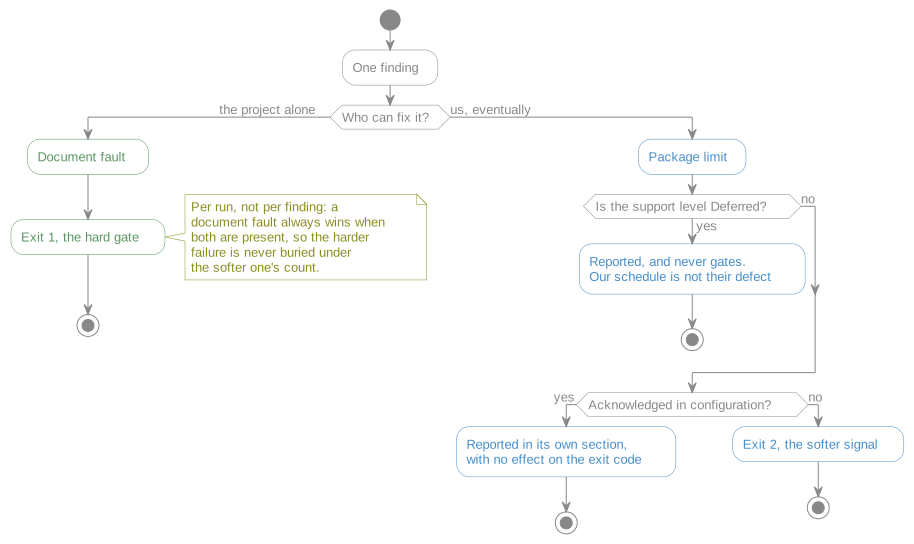
How a finding reaches an exit code.
The diamond at the top is the whole classification rule, and the section below is what made it that question rather than whether the document parses. Of the four endings, two gate a pipeline.
The rule that follows from this: a package limit is never reported as if the consumer made a mistake. They wrote a valid contract. We are the ones who cannot serve all of it yet, and the message says so.
Who can fix it decides
The two-class model above was first written about the document alone, and three findings do not fit that reading: drift, installation, and operationId missing on a public + stable operation. None of the three is the document failing to parse, and none is this package refusing a construct it does not support either, so each was, for a while, filed as a document fault with an in-code comment apologizing for it. Three findings needing the same exemption is the model missing a case, not three sites each owing an argument.
Decided: the dividing line is who can fix it, and a document fault is anything only the project can. That covers all three:
operationIdonpublic+stable. The key is optional in OpenAPI, so the document is valid, but the document made the promise, and this package publishes the rule that the promise requires an identity that survives a rename. Only the author can add it. The finding still carries itsPartialsupport level, which is what says the construct is honored when present.- Drift. The specification and the generated tree disagree.
spec:buildis the fix, and only the project can run it. - Installation. The project's
generated.path,generated.namespaceandcomposer.jsondisagree with each other, or its.gitignoreexcludes a directory its build depends on. Nothing in this package can settle any of that.
A package limit stays what it always was: the document is correct and we do not honor the construct. That is the class whose message must never read as the consumer's mistake, and the narrowing above is what keeps the three findings that are the project's own problem out of it, where their softer exit code would have understated them.
What it checks
Provisional, and expected to grow one section per honored construct.
Every section in this table prints on every run, including the two this release does not check. Baseline and Drivers have no inputs yet, so each prints a [not checked] line naming what it does not diagnose, and the summary names them again. A section absent from the report is one a green exit silently claims to have covered. The same mechanism carries a section skipped on this run: drift is not checked when the document could not be read, because spec:build would refuse that document before writing anything, so nothing would be written or pruned.
A section comes off that list in the change that builds it, which is the only way an entry is meant to be removed. Security and Lifecycle were both on it one release ago and are not now.
| Section | Answers |
|---|---|
| Configuration | Are the spec files found and readable? Which allowlist and options are in effect? |
| Document validity | Is this valid OpenAPI? The parser does not answer this in its library API, see parser caveats, so the doctor owns it. |
| Version | Which version was detected, and which strategy will handle it. |
| References | Unresolved $ref, references blocked by the allowlist, and $ref cycles, checked before the document reaches the parser, which exhausts memory on them rather than raising. See the parser caveats. |
| Support findings | Every Partial, Ignored and Rejected construct in the document, with its position where the section computes the finding itself, see the contract for the two cases that carry no pointer, and why neither is a gap. Deferred constructs get one summary line each, naming a count rather than a position, because the level's own definition forbids one finding per occurrence. |
| Routing outcome | The routes that will be registered, in order, with their targets, plus shadowing, where an earlier templated path swallows a later one, literal or templated. A stated limit: only a path swallowed entirely is reported. An earlier /users/{id} shadows a later /{owner}/{repo} for requests whose first segment is users and no others, and calling a route that answers every other value "never reached" would be false. Being unreachable for some inputs is a different finding, and not one this section makes. |
| Security | Today, one thing: every operation whose contract declares security, listed individually, because this phase registers its route without applying any of it. Once enforcement lands, that finding is deleted and this section becomes a securitySchemes name with no guard of the same name, a scheme type the built-in middleware cannot enforce at all, and an authenticated model missing the interface the middleware calls. Its own section rather than a line among others, either way, because it is the one finding that can turn a documented-as-protected endpoint into a public one. |
| Drift | Whether the generated code still matches the specification. The runtime cannot notice that someone edited the spec and forgot to build, so this check is the only thing standing between that mistake and production. |
| Lifecycle | The x-sunset and x-lifecycle rules, plus the protection report: how many public operations are actually stable, and therefore how much of the API is protected at all. A removal date that has passed is a finding; one that is merely approaching is reported beside the protection report and never touches the exit code, so a run cannot fail on a day nobody changed anything. |
| Installation | That the vendored directory is not gitignored, and that the generated path and namespace agree with what composer autoloads. Both are silent misconfigurations whose symptoms appear far from their cause. |
| Baseline | Whether the specification's previously committed version can actually be read from git: reachable history, not a shallow clone, and the file itself tracked rather than gitignored. Without this, breaking-change detection silently compares against nothing and reports a clean run for the wrong reason. |
| Drivers | For each driver-based feature: an unrecognized driver name, and a mapping missing a key its driver needs. Plus each feature's own structural rules, which the feature owns. For rate limiting, 429 declarations that disagree between operations, since one mapping cannot serve two spellings of a header. |
Running it in CI
What each exit code means is in the command reference. What follows is the part a reference cannot carry: which rules produce a non-zero code, and what to do about it.
The git requirement is there too, and the reason is here: the vendored-directory check asks git check-ignore rather than reimplementing .gitignore resolution, see stack.md. A slim CI image that installs PHP and not git gets a report one check short, and the Installation section prints what it could not determine rather than passing quietly.
Two rules make a previously green contract go non-zero, and both are permanent by design. They are the reason to read this section before wiring the command into a pipeline that already passes:
- A contract declaring operation-level
securityexits2, every run, until enforcement lands. There is no opt-out, and that is the point: the route is registered with no authorization check behind it, so an endpoint the contract documents as protected is served as public. See security.md. - A
deprecated: truewith nox-sunsetexits1. Harder edge, because it is a document fault rather than a package limit: it gates hard, and only the contract's author can fix it. See the lifecycle rules.
Exit code 2 is not a failure in the usual sense, and spec:doctor || exit 1 treats it as one. 2 means the document is correct and this package does not honor part of it: a roadmap item, not a defect in the contract. Whether that should stop a pipeline is a policy choice, and it has to be made deliberately:
# Gate on document faults only; report package limits without failing.
php artisan spec:doctor; code=$?
[ "$code" -eq 1 ] && exit 1
[ "$code" -eq 2 ] && echo "::warning::spec:doctor reported package limits"
exit 0
A team that wants both to fail writes spec:doctor on its own and lets any non-zero code through. What no team should write is a recipe that fails on 2 without having decided to, which is the reason the two codes are distinct at all.
Open questions on the doctor
- What still happens at boot.
Rejectedfails at boot unless acknowledged, in which case the construct is skipped. The doctor is a check, not a substitute for refusing to load a spec the package cannot serve. Whether anything belowRejectedsurfaces at boot at all, or whether the doctor is the only channel, is still open. Since the runtime loads generated PHP rather than a specification, "at boot" now means "baked into what the build emitted", which narrows the question rather than answering it.
The usage details now live in the command reference, and this page keeps the reasoning. What stays here rather than moving is everything that makes the support levels mean anything: which findings gate, who can fix each one, and what a clean run does and does not promise.
Acknowledged limits: the consumer's opt-out
A consumer can declare, in configuration, that they accept a limit, and the package then stops treating it as a problem.
Rule 2 assumes the reader can act on the diagnostic. Often they cannot. The spec comes from another team, from a vendor, from a generator that always emits the same construct, and it is not theirs to change. For that developer a permanent, unfixable warning is not information. It is a broken window, and the first thing they will look for is the switch that turns the whole package quiet. Better to hand them a precise switch than to let them reach for a blunt one.
Acknowledgement is not the same as suppression, and the difference is the whole design:
- It is enumerated, never global. You list the specific constructs you accept. There is no "silence everything" option, because a spec that grows a new unhonored construct next month must still speak up: you never acknowledged that one.
- It stays visible. Acknowledged items still appear in the doctor's report, in their own section, not folded into a count and not hidden. They stop failing; they do not stop existing. A configuration file nobody ever reads again is how accepted debt becomes forgotten debt.
- Stale acknowledgements are themselves a finding. When a construct you acknowledged no longer occurs in your spec, or the package has since grown support for it, the doctor says so, and you delete the line. Without this, the config only ever accumulates.
- It is reviewable. It lives in the application's config file, in version control, in diffs. The closest analogue in this ecosystem is a PHPStan baseline: an explicit, versioned list of accepted debt, where new violations still fail the build.
Acknowledging changes behavior, not just noise
The documentation must never understate this. Acknowledging a Rejected construct is what allows the spec to load at all, so it is also the moment the construct is dropped. Acknowledge a trace operation and the document still describes an endpoint that will answer 404. That is a legitimate choice, and it is the consumer's to make, but the report has to state the consequence in those terms rather than reporting a clean bill of health.
Which is why security acknowledgements are never collapsed. A consumer may accept that a securitySchemes type is not one the built-in middleware can enforce at all, mutualTLS for instance, and that is their call, but every affected operation is listed individually, on every run, forever. This is the one place where being annoying is the correct behavior: the finding is that an endpoint the contract describes as protected is not.
Open questions on acknowledgement
- Granularity. Per construct (
trace: acceptedeverywhere) covers the vendor-generator case that motivates the feature. Per construct and location covers the one weird endpoint. Starting at the construct level and widening later is a minor release; the reverse is not. - Whether a reason string is required. Requiring a justification on each entry is friction that pays for itself the day someone reads the config a year later and cannot remember why. It is also the kind of opinionated requirement rule 3 invites.
- The scope of a
Rejectedacknowledgement — skipping the offending operation is the leading answer, with arejected_behavior: skip | failstyle option if the choice turns out to be worth giving away. Deliberately left to be settled against real code rather than in the abstract: the difference between the two only becomes concrete once there is a spec loader to watch. - The config keys themselves. Public API surface. Not chosen.