Controllers
In brief
- Each operation gets its own controller, holding one method, always called
routeAction.x-controlleris how you take an operation over: it names the class you will write, and the generated parent drops itsfinalso you can extend it.- An operation that declares no
x-controllergets afinalcontroller, which nothing can extend.spec:makeis the only command that creates a file you own. The build never does; it names the command instead.- Not built yet:
x-modeland everything model-shaped, which is Phase 2.
An operation needs something to answer it. This document owns what that something is: how many files it takes, what it assumes about your application, and where a developer's own code attaches to it.
Partly shipped, and this document spans two phases.
spec:buildemits one controller per operation, each carrying onerouteActionover the shippedSpecControllerbase with itsmiddleware()method, and answering 501. The two-class seam is shipped whole:x-controlleris read, a declared controller names the generated parent and drops itsfinal, the route points at the child once that class exists, and two values reducing to one parent is a build error naming both.spec:makeships whole: its three forms, the insertion prompt below with the edit verified on a copy, and the build it runs afterwards. Nothing in Phase 1 is left in this document. Phase 2 carries everything model-shaped:x-model, the CRUD defaults,HasModeland its trait, the marker interfaces, the DTO factory calls, the pagination seams and the mass-assignment check, because a generated CRUD body has nothing to return until the DTOs exist. Items markedOpenare undecided.
One controller, one routeAction
Every operation gets its own generated controller, carrying exactly one route method, always named routeAction. Not a resource controller holding several operations, and not an invokable class.
One fixed method name rather than one derived from the operation, and the reasoning is predictability: every controller this package generates has routeAction, so "which method do I override" has one answer, forever, with no naming convention to learn and no derived spelling to reconstruct. The operation's identity is carried by the class name and stated exactly in the file's own docblock, which is where a reader looks anyway.
Two alternatives were considered and dropped:
- Grouping several operations into one controller. A controller generated with five abstract methods needs a concrete subclass implementing all five before PHP will instantiate it, so you cannot ship three today and two tomorrow. One operation per class removes the problem entirely rather than managing it. Grouping is also what
x-controllerwas first considered for; it does something else here, and nothing in this package produces a shared file. - An invokable.
routeActionappears in the generated route registration, in stack traces, in IDE navigation, and in a grep for every spec-driven action at once.__invokeappears in none of them: it is a magic method whose name says nothing about what it does, and the route registration degrades from an explicit[Controller::class, 'routeAction']pair to a bare class string.
The signature is the contract
routeAction declares one parameter per path parameter, string, named the way the specification names it.GET /users/{id} generates routeAction(string $id): mixed.
PHP is what makes this a decision rather than a detail. An override may not add a required parameter, so a parent declaring none would forbid every custom controller from ever seeing {id}, and a developer could only reach it through the request object, which is the opposite of what a generated seam is for. It was found in the Workbench rather than by reasoning: a child declaring routeAction(string $id) over a parameterless parent is a fatal error at load.
Named, because Laravel matches route parameters to method parameters by name rather than by position. That makes the specification's spelling load-bearing here in a way it is not elsewhere: renaming {id} to {userId} changes this signature, and a child overriding it has to follow. Identity is still normalized, because that question is asked for rename detection rather than for signatures, and the two must not be conflated.
string until something says otherwise. A route parameter is text on the wire; x-model is what will turn one into a bound model, and the parent will declare that type when it does. A child may narrow the return type, array where the parent says mixed, but not the parameters, which is ordinary PHP variance rather than a rule of this package.
And a path parameter that cannot be a PHP variable is refused, naming it. {2fa} is a legal route parameter and $2fa is not a variable, so the build says so rather than emitting a file that will not parse; {this} is the same problem from a different direction. This is a second check rather than a stricter first one, because the neighbouring refusals belong to other rules: a character the router would never match is refused for being unroutable, and one path naming the same parameter twice is refused where the path is read, before anything asks what could be generated from it.
The contract decides what is customizable
It follows from the package's own name. lara-spec-first means the contract leads and PHP follows, so whether an operation has custom code is a fact the specification states, not a convention this package goes looking for in the filesystem. Any other answer would put the code in charge of something about the contract, which AGENTS.md calls going the wrong way, and which is the one direction this project does not travel.
That reasoning is worth writing down rather than assuming, because the alternatives all look reasonable in isolation and every one of them inverts the direction:
- An attribute on the developer's class. The class now decides whether the contract has a custom implementation.
- A scan for whatever extends a generated parent. The filesystem decides, and the answer changes with a refactor.
- A config key listing customized operations. A third file decides, and it is the one nobody updates.
Each puts the answer in PHP. Only the specification saying so keeps the direction intact.
x-controller on an operation carries the fully-qualified name of its custom controller, the same way PHP itself writes a class reference. It is not a grouping key and it does not name a base class to extend. It names this operation's controller, one operation to one class, and its only job is to be that name.
x-controller: App\Http\Controllers\UserControllerA full name rather than one relative to a configured root, because an FQN needs no second setting to resolve and cannot be read two ways. There is nothing to concatenate, so there is nothing to get wrong.
| The operation declares | Generated class name | Extendable |
|---|---|---|
x-controller | Derived from x-controller | Yes |
| Nothing | Derived from operationId, or from the method and path when absent | No, final |
That table is the whole design, and the reason is one property: the extendable class's name comes from a value that exists only to name it. x-controller has no other meaning in the contract, so nothing else can move it. An operationId can be renamed, or added to an operation that never had one, and the doctor actively encourages adding one, which under any name-from-operationId scheme means the package nudges you toward breaking your own imports. Deriving the extendable name from x-controller instead means the only thing that can break an import is the developer changing the name they chose themselves, which is the deliberate versioning decision this package already says an identifier change is.
And final is what makes that guarantee real rather than advisory. An operation with no x-controller has a derived name, the documentation has always called derived names disposable, and final stops anyone from building an extends on top of something disposable. Declaring x-controller is how a project says "this name is mine now, I intend to depend on it."
The same rule generalizes past controllers: anything whose generated name is derived rather than declared is final. A DTO factory named from a components/schemas entry is extendable because that name was chosen; one named from an inline, anonymous response schema is not.
Two classes, found by name
A customizable operation therefore has two controllers: the generated parent, rewritten on every build, and the custom child, created once. The build does not scan for the child, because the specification already told it the name, so resolution is a lookup rather than a search. That is simpler than the factory override mechanism, which has to scan configured directories precisely because nothing in the specification names a factory override.
The route points at the child when it exists, and at the generated parent when it does not, resolved at build time, so the registration stays a serializable pair of strings and route:cache keeps working.
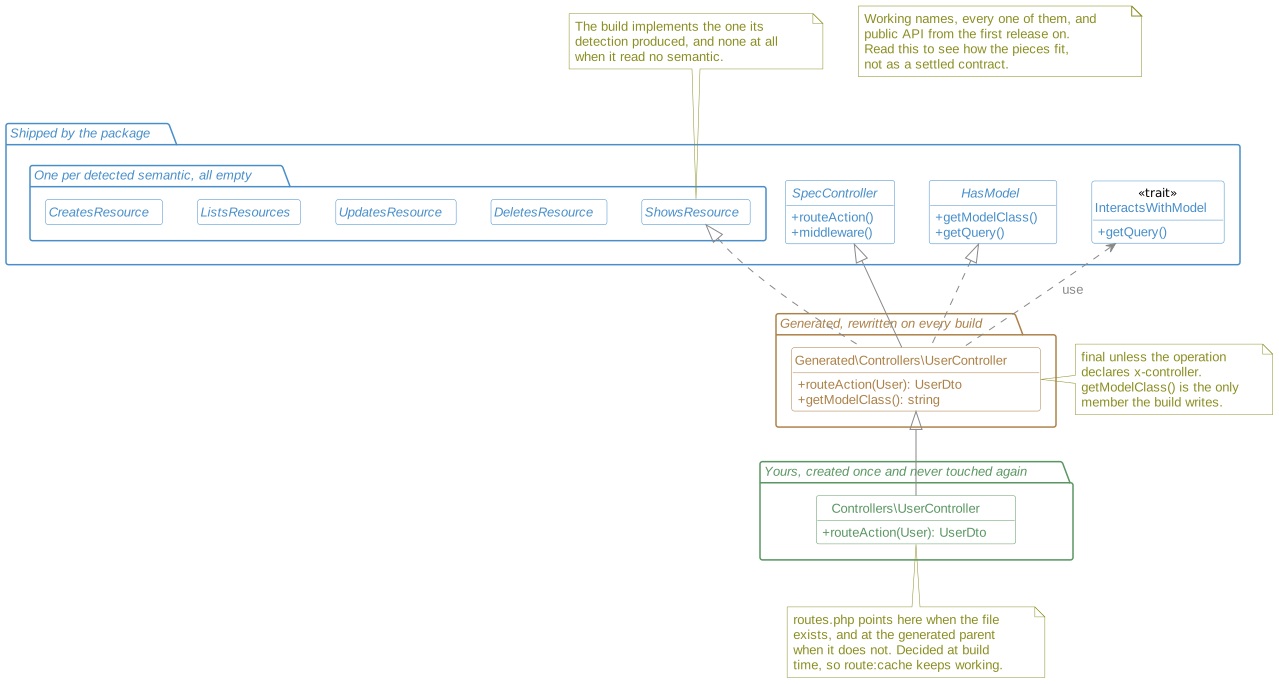
The two-class seam, and the types the three layers share.
Who rewrites each layer is the part a paragraph keeps having to restate: the package ships the base, the interfaces and the trait, the build owns the middle layer entirely, and the bottom one is written once by a person and never touched again. That is the structure; the request path is the same layers seen from a request arriving.
The names in it are working names, and the picture is a reading aid rather than a settled contract. Every interface and trait it draws is public API surface under rule 4 from the first release on, and settling those names is still open. It is drawn from what this document set claims today, so read it for how the pieces fit and read the section that owns a name before depending on it. Expect to revisit it rather than to inherit it.
The generated parent takes the same short name, inside the generated namespace, and the child extends it by fully-qualified name. No use, no alias, no suffix:
namespace App\Http\Controllers;

class UserController extends \App\Http\Generated\Controllers\UserController
{
    // override what you need.
}
An inline FQN in the extends clause is ordinary PHP and it removes the whole problem the alternatives created. A suffix on the generated side would mean inventing a naming convention nobody asked for; importing a same-named parent would force use …\Generated\UserController as GeneratedUserController into every custom file a developer owns. Writing the name where it is used costs one line and reads as exactly what it is: this class is the generated version of me.
Two x-controller values that reduce to the same generated parent are a build error, naming both. Distinct FQNs can still share a short name, …\Admin\UserController and …\Api\UserController, and silently letting one generated parent serve two operations is the kind of guess this package refuses everywhere else. Its message is its own rather than the collision message an operationId gets, because the fix is a different one: neither of these operations is being named from an operationId, so advice about that key would send a reader looking for something they do not have.
And an x-controller inside the generated namespace is refused too. The generated parent takes the same short name there, so the child would extend itself, and a build rewrites everything under that namespace, so the work would not survive one.
The child is looked for by file, not by loading it. Asking PHP whether the class exists would load it, and a child extending a parent this build has not written yet is exactly what a first build meets, so the question would raise on the missing parent while planning the file that would have fixed it. The autoloader is asked for the file instead, with the same PSR-4 rules it applies at runtime and without executing a line. A child that exists and cannot load yet is still the class the route belongs to: it works the moment the build writes its parent, and answering otherwise would make the build's output depend on whether a previous build had run.
spec:make is the only way in
A custom controller is created by spec:make and never by the build, which is the invariant rather than a new rule. It scaffolds one file for one operation, extending that operation's generated parent. Its arguments and flags are in the command reference.
Shipped, except the insertion. The command creates the class, refuses to overwrite one, and names what it cannot scaffold. What it writes is deliberately almost nothing: the extends, the comment about that one line, and the signature to override.
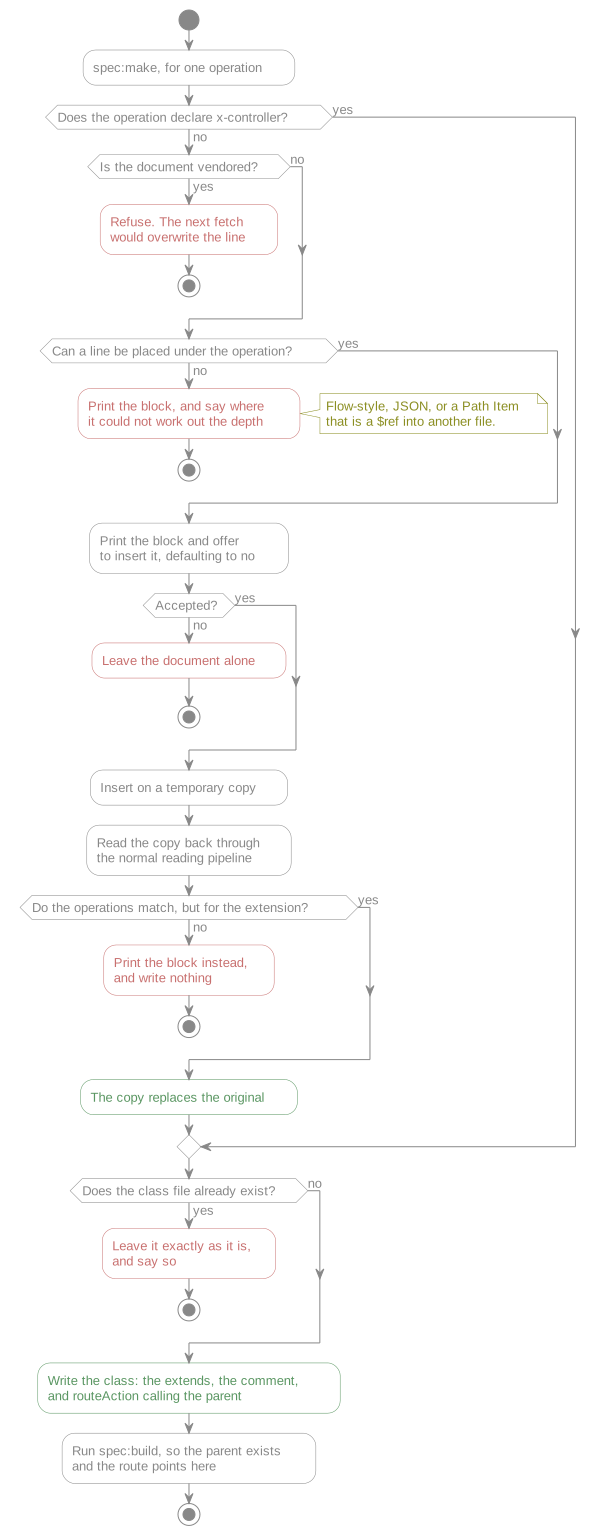
What spec:make decides, and where it stops.
The whole command in one picture, and the subsections below take each branch in turn. Four of its five decisions are refusals, which is the shape of a command that edits the source of truth and writes a file a developer will then own: the nominal path is short, and everything else is a reason to stop and hand the decision back.
It writes routeAction with the signature the parent declares, and one line in it. Writing the method is what a make is for: the signature is the fiddly part, PHP will not let a child widen it, and copying it out of a comment is work a generator should have done.
That one line is a call to the parent, and it is not decoration. A method with an empty body returns null, which Laravel renders as an empty 200, so an empty scaffold would quietly turn the operation's honest 501 into a lie, in the one command whose whole job is to help. The parent call keeps the 501 until the developer replaces it, and replacing it is exactly what implementing the operation means:
// The parent below is generated. If PHP cannot find it, run `php artisan spec:build`.
// If it still fails, the specification no longer has an `x-controller` pointing here.
class UserController extends \App\Http\Generated\Controllers\UserController
{
    public function routeAction(string $id): mixed
    {
        // Replace this line with your answer to `get /users/{id}`.
        return parent::routeAction($id);
    }
}
And the command builds when it is done. A developer adds x-controller and runs spec:make: the class it names has no generated parent yet, because that parent's name comes from the extension the build has not read. The file would not load, in the very moment they are looking at it. So spec:make calls spec:build after writing, which also points the route at the child, since that target is resolved at build time. This is not the invariant in reverse: the rule is that the build never creates a class you will own, and nothing says the command that does may not ask the build to catch up. It is skipped after a declined bulk confirmation, because a refusal is respected whole.
The scaffold is not a publishable stub
The scaffold is not a publishable stub, and what a stub would have to leave alone is the reason. Every Laravel generator worth copying lets a project publish its stubs, so the absence is a choice rather than an omission.
Almost every line here is derived. The class declaration carries the parent's fully-qualified name, which the build's naming rule produced; routeAction's parameter list is the path's own, and PHP forbids a child from widening it. A stub can hold placeholders for those, but a stub whose placeholders are all mandatory is a template with one editable region: the comment.
And its failure mode is quiet. Drop extends from a published stub, by accident or because a placeholder was renamed, and spec:make writes a class that compiles, that the route still points at, and that answers nothing the contract described. This is the one file in the package where nothing is guessed; a template is a way to reintroduce guessing.
The cost also arrives at the wrong moment. Published stubs are public API surface under rule 4, and the body is exactly what Phase 2 changes: x-model, the CRUD defaults and the DTO factory calls all land inside routeAction. Publishing a stub contract now means choosing between breaking every published stub then, or freezing a shape this document already calls provisional.
Revisit when that body settles. If it earns a stub then, the shape to prefer is a stub for the frame with the load-bearing lines inserted rather than templated, the parent, the signature and the call that keeps the 501, so that a published stub cannot silently unhook a class from its own operation. Until then the answer to wanting a different file is that the file is yours: spec:make writes it once and never touches it again.
The command offers to write it
spec:make prints the extension to add, names the exact line, and offers to insert it, defaulting to no.Shipped. Wanting a custom controller and having to hand-edit YAML first is friction with no purpose, but the specification is the source of truth and nothing writes to it without being asked:
get /users/me declares no `x-controller`, so its generated controller is `final` and cannot be extended.

  Add to openapi.yaml, line 26:

      x-controller: App\Http\Controllers\ShowCurrentUserController

Insert it there now? (yes/no) [no]
The value is derived, not asked for. It is make.controllers from the configuration, App\Http\Controllers by default, plus the short name the build would have generated anyway: the operationId studly-cased and suffixed, or the method and path for an operation with no operationId. So a developer types spec:make showUser and never a fully-qualified class name.
Only the namespace is configured, because the directory follows from PSR-4. Asking for both would be two places that can disagree about one file, and the project's own composer.json already answers the second, which is the same map spec:make uses to decide where to write the class.
And the configured namespace never renames anything. What ends up in the document is the value the developer accepted, and from that moment the document decides the class name: changing make.controllers later changes what the next insertion proposes and nothing that was already inserted. That is the whole reason x-controller is the only source of an extendable name, stated from the other direction.
Answering no leaves a copyable block and the exact line, which is the pattern this package already uses when a human decision is required. Answering yes runs the insertion below, and then scaffolds the class and builds: one command from an operation the contract says nothing about to a class the route reaches.
A developer who does not want to be asked types --yes, never --force. --tag= and --all are the same primitive run several times, one file per operation, since nothing this package creates is a grouped file, and both list what they would create and ask before creating anything, defaulting a non-interactive run to no. --yes answers that confirmation and the extension prompt above with the answer the command already proposed, including under --no-interaction, which is the whole reason the flag exists: an explicit --yes on the command line is somebody naming the class, given in advance instead of at a prompt.
The name is --yes and not --force because the two words already mean different things in every Laravel generator. --force means overwrite what is there, and this command never overwrites a file a developer owns. None of the guards moves for --yes:
- A file that already exists is still left exactly as it is.
- The insertion still verifies itself on a copy before anything replaces the original.
- A name this project could not place is still refused, loudly.
Borrowing --force would promise the one thing this command refuses to do.
The insertion verifies itself
The insertion never round-trips the document through a YAML dumper. Parsing and re-emitting destroys comments, key order and anchors, and this is the one file read in every pull request. YAML's indentation is predictable enough that there is nothing to parse for: the operation's line is known, and one line goes in beneath it at the matching depth, with nothing parsed, reformatted or reflowed.
And the edit verifies itself before it lands. The insertion happens on a temporary copy, the copy is read back through the normal reading pipeline, and the resulting operations are compared against the ones the original produced. Everything must be identical except the extension that was just added. Only then does the temporary copy replace the original.
If that comparison fails, nothing is written. The command stops, says the automatic insertion would have changed something it did not intend, and falls back to printing the block for a human to place. That path should never run, which is exactly why it must exist: an automatic edit to the source of truth is worth a check that cannot be argued with.
It refuses to offer at all on a document it cannot place a line in. Three shapes, each of which this package still builds from happily and none of which it may edit blind:
- A flow-style mapping, where there is no line beneath the operation to indent against.
- A JSON specification, which this insertion has no rules for at all.
- An operation whose Path Item is a
$refinto another file, so the line would land in the wrong document.
The command prints the row, says it could not work out where the line goes, and stops. That is a refusal to guess rather than a limitation of YAML editing: the alternative is a line written at a depth nobody chose.
And it refuses outright on a document the project does not own. An operation reached through a vendored remote reference lives in a file the next fetch overwrites, so an insertion there would silently disappear. That has a broader answer behind it worth saying plainly: a specification you do not control is the consumer's problem, not this package's. Building an application on a contract someone else can change under you is already a risk this package cannot design away, and bending the whole customization model around it would cost every other project clarity. Vendor the reference, or own a copy.
What the generated controller contains
Inheritance carries exactly one thing here, the two-class parent-child seam above, and nothing else. SpecController is one abstract base, shared by every operation, and it stays deliberately thin: no per-operation knowledge, because it cannot have any.
Everything an operation needs is generated into its own class, narrowly typed. An earlier draft of this design put that knowledge in context objects the controller composed, a ModelContext holding the model, the query, the response and the write defaults. Those are gone, because once the generated method calls the DTO factory directly there is nothing left for a context to hold, and a delegation into an object graph reads worse than the explicit code it was hiding.
routeAction is one line, calling a named CRUD method the build chose.
// Generated. `final` here because this operation declares no x-controller.
final class GetUsersIdController extends SpecController implements ShowsResource
{
    public function routeAction(User $user): UserDto
    {
        return $this->respondWithSingle($user);
    }

    protected function respondWithSingle(User $user): UserDto
    {
        return UserDtoFactory::from($user);
    }
}
The dispatch is resolved at build time, never at request time. An operation is exactly one HTTP method, so GET /users/{id} is never a POST and a match on the request method would be four dead branches. The build knows which method the operation declares and emits the one call that applies.
Two methods rather than one, and the split earns its keep on writes. For a single read the two signatures are identical, so the indirection buys nothing there and is kept only for consistency. On a write it is what the split is for:
public function routeAction(StoreUserRequest $request): UserDto
{
    return $this->create($request->validated());
}

protected function create(array $validated): UserDto
{
    return UserDtoFactory::from($this->getQuery()->create($validated));
}
A child overriding create() receives array $validated and never touches the request object or the route signature. routeAction owns the HTTP seam; the CRUD method owns the work.
x-model turns on the model layer
x-model is the switch for the whole persistence layer. Declaring it gives an operation a model contract, a default query, CRUD defaults and a DTO factory. Declaring nothing gives it none of them, and its routeAction throws the 501 rather than pretending.
| The operation declares | Generated controller gets |
|---|---|
x-model | The model contract, a query, the CRUD method its semantic implies, and a DTO factory |
| Nothing | A routeAction that throws, and no CRUD interface at all |
Without x-model there is no DTO factory either, and the reason is worth being precise about: a factory's default mapping works by matching a DTO's properties against a source, and with no model declared there is no source to match against. The build would have nothing to write. So the DTO class is still generated from the response schema, and constructing it becomes entirely the custom controller's job.
Which is not the same as the package doing nothing for you. A no-x-model operation still gets its route, its FormRequest derived from the request body schema, and its DTO class derived from the response schema, everything the specification can state on its own. What it does not get is a guess about persistence. "No x-model" does not mean the package will not help you; it means the package will not guess at your persistence.
That framing is the whole shape of this package, and it is worth stating once plainly: x-model, and rate limiting and pagination beside it, are extras that remove redundancy. They go as far as replacing everything that is obvious, so that a developer spends their attention on what actually carries value. They are not the point of the package, and nothing breaks without them.
An interface, and a trait beside it
An interface declares the model contract, and a trait ships the implementation that can be shared. The interface is the type, and a trait is not one, which is the whole reason both exist:
// The type. What anything reasoning about a model-backed controller depends on.
interface HasModel
{
    public function getModelClass(): string;

    public function getQuery(): Builder;
}

// Shipped by the package. Only the part that can be written once, for everyone.
trait InteractsWithModel
{
    public function getQuery(): Builder
    {
        return ($this->getModelClass())::query();
    }
}
The generated class then supplies the one fact only it knows:
final class GetUsersIdController extends SpecController implements HasModel, ShowsResource
{
    use InteractsWithModel;

    public function getModelClass(): string
    {
        return User::class;
    }

    public function routeAction(User $user): UserDto
    {
        return $this->respondWithSingle($user);
    }

    protected function respondWithSingle(User $user): UserDto
    {
        return UserDtoFactory::from($user);
    }
}
This interface carries real methods, unlike the CRUD markers below, and the difference is not a matter of taste. getModelClass() and getQuery() take no parameters, so an implementation can satisfy them exactly and a child can override them freely. respondWithSingle(User $user) does take one, and PHP requires parameter types to be contravariant, so an interface declaring respondWithSingle(Model $model) would forbid the narrowly-typed generated method above. A parameterless method can be a contract; a method that receives the bound model cannot. That single rule decides which family an interface belongs to, so neither is an inconsistency.
Only getModelClass() is generated, because it is the only part that differs per operation. getQuery() lives in the trait so its default exists in one place rather than repeated across every model-backed controller, and it stays the seam a project overrides most often: a global scope, eager loading, hiding soft-deleted rows are all legitimate query construction that never contradicts what the specification declared. Both, and the trait, are drawn in the seam diagram above.
The CRUD semantic is an empty marker
Alongside HasModel, the generated class implements an empty interface naming the CRUD semantic the build detected, one interface per semantic, each declaring no methods at all.
Empty follows directly from the parameterless rule above: a CRUD method receives the bound model, so no interface can declare it without giving up the narrow typing. And even where it could, it should not: a method-carrying interface would constrain the shape of every override, which is exactly the freedom this design means to leave open. The contract that binds is routeAction's return type, and PHP already enforces that. Constraining convenience past it is how a design gets rigid for nothing.
What the marker buys over the docblock that already states the same finding:
- It is on the declaration line, so the semantic is the first thing anyone reads, human or agent.
- It is greppable and
instanceof-able, without parsing a comment or reflecting over an attribute. - It is where the vocabulary is defined. The interface's own docblock explains what this package means by a create, a collection read, and so on, so go-to-definition lands on the explanation rather than on nothing. That is the reason it is an interface rather than an attribute.
And no interface is a signal too. An operation the build could not read a semantic from implements none, and its routeAction throws. The declaration line therefore tells the whole story either way. All five are drawn in the seam diagram, where the generated class implements exactly one of them.
One framing precision, because the marker could otherwise lie. A custom child inherits it and is free to reimplement routeAction as something else entirely. So the interface documents what the build detected in the specification, never what the class does. It is a finding, in the same sense the docblock's findings are, and it stays true no matter what a developer writes on top of it.
Open: the names. HasModel, InteractsWithModel, CreatesResource, UpdatesResource, DeletesResource, ShowsResource and ListsResources are working names, and each is public API surface under rule 4 from the first release on. Settling them before that release costs nothing; after it, adding a member to any of them is a breaking change.
How the semantic is detected
Two signals, and each answers a different question. Neither is a heuristic on words.
| Question | Signal |
|---|---|
| Single item or collection? | The response schema. type: array is a bare list; a type: object whose configured mapping.collection key names an array property is an enveloped, paginated list; anything else is a single item. |
| Creating, or acting on one? | Whether the path binds the model. No parameter means the resource does not exist yet; a parameter means it does. |
The response schema decides the read shape rather than the path, and the counter-example is what settles it: GET /users/{id}/invoices carries a parameter and returns a collection. The parameter says what is addressed, the schema says what comes back, and for choosing between a single and a collection it is what comes back that matters. Hardcoding the envelope property to data instead of reusing the pagination mapping would be the same two-sources-of-truth failure this document keeps avoiding.
The path parameter settles the write side:
| Operation | Parameter | Detected |
|---|---|---|
POST /users | no | create |
POST /users/{id}/activate | yes | nothing |
PATCH /users/{id} | yes | update |
DELETE /users/{id} | yes | delete |
A POST on an already-addressed resource is an action, not a creation, so the build detects nothing and the operation answers 501 rather than mass-assigning into a model that already exists. Guessing there would not be a harmless mistake: POST /users/{id}/activate with x-model: User would create a bogus record. And a developer whose endpoint departs from these semantics is free to declare x-controller and write whatever the operation actually does, which is the escape hatch, working exactly as intended.
PUT and PATCH share update(). The difference is what the request must carry, not what the controller does, so it lives in the generated FormRequest: PUT requires the full body, PATCH makes fields optional. One honest caveat, because it is a real semantic gap most APIs ignore: strict PUT replaces the resource, so an absent field should return to its default, and $model->update($validated) does not do that. A project that needs replacement semantics overrides update().
The factory is not imposed
The generated CRUD method calls the operation's DTO factory, and the generated code says in a comment that keeping that call is strongly recommended.
A comment rather than a constraint, and the reason is worth stating so it does not read as softness: bypassing the factory does not break anything. A child that overrides respondWithSingle() and builds its DTO by hand still returns a UserDto, and the return type already enforces the only thing the contract cares about. The factory is where mapping belongs, which is a separation-of-concerns argument rather than a correctness one, and this package does not put a structural barrier in front of a choice that cannot go wrong.
Middleware is a method
SpecController implements Laravel's own HasMiddleware interface, with a default middleware() returning nothing. A project needing middleware on one operation overrides that method in its custom child, so middleware is the same shape as every other extension point rather than a second thing to learn: no implements clause to remember, and one list of overridable methods to read.
Everything the specification derives stays on the route, never in middleware(). That is already what security.md decided for the scope check, and keeping it there is what makes overriding middleware() safe: Laravel combines route middleware with controller middleware rather than replacing one with the other, so a child cannot drop its own security by forgetting parent::middleware(). There is nothing of ours in that method to preserve.
Two consequences of using Laravel's interface as-is: middleware() is static where the others are instance methods, and being static it cannot reach instance state, so middleware stays declarative, which is the right constraint anyway.
x-model and x-controller are independent
The two extensions answer different questions and neither implies the other:
| Declares | What the operation gets |
|---|---|
x-model alone | A working default with no code written at all, and a final generated controller |
x-controller alone | A custom child that owns routeAction entirely, over a parent that throws |
| Both | A working default a custom child can override method by method |
| Neither | A 501, which is the honest answer when nothing has said what the operation should do |
The third row is the common case for anything interesting: the defaults handle the shape, and the child takes over only the part that earns a developer's attention.
Reads need no code at all
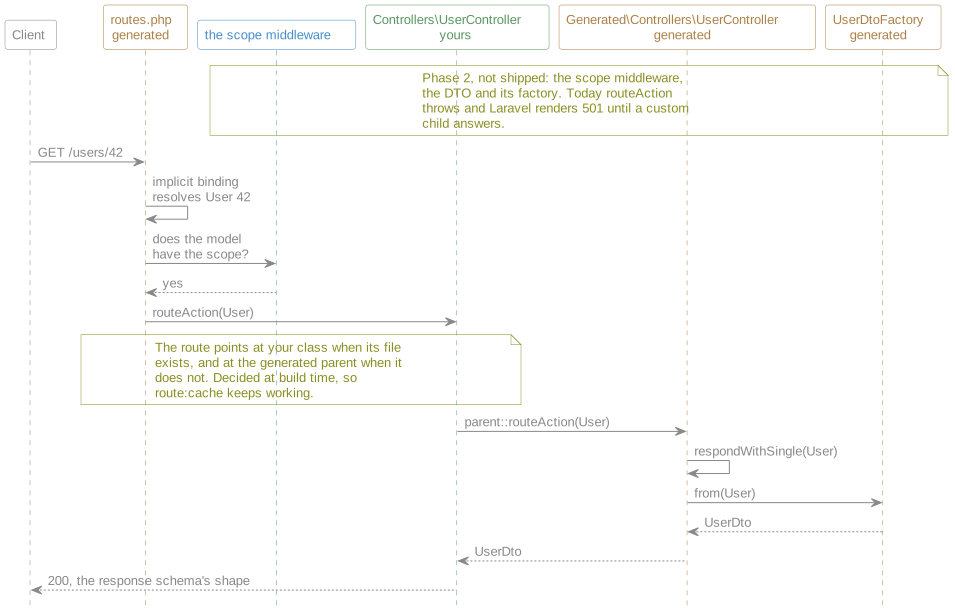
The path of a request, from the route to the DTO factory.
One level below the two-class seam: the same classes, in the order a request reaches them. Every hop after the route is a method a child may override, and the phase note names the three participants that do not exist yet.
A single-resource read needs no override at all. Laravel's own implicit route-model binding resolves it: the generated method's parameter is type-hinted with the model class, a build-time decision, and Laravel does the actual binding at request time with no package code involved, consistent with the runtime never seeing the spec. The type hint comes from x-model, so one value in the specification feeds three things: this hint, the factory the generated method calls, and getQuery()'s default source. One fact, three consumers, never two answers.
A collection read has nothing bound to receive, so its routeAction takes no model and respondWithCollection() starts from $this->getQuery(), handed to pagination's built-in driver when the operation's response declares a page.
This package ships no filtering or sorting. OpenAPI has no vocabulary for a filter DSL any more than it does for row-level authorization, and the same test applies: inventing one would be a far larger commitment than anything else in this document set, for a feature every serious Laravel project already reaches for a dedicated package to solve. getQuery() is already the hook: override it and wire in Spatie's Query Builder, Scout, or whatever the project already uses.
Writes, by the same default
create, update and delete get the same treatment as reads: a generated default built from x-model and the request's already-validated data, and a custom child free to override either the CRUD method or routeAction for anything more than plain mass assignment:
| Detected | Generated default |
|---|---|
| Create | $this->getQuery()->create($validated) |
| Update | $model->update($validated), $model bound as above |
| Delete | $model->delete(), $model bound as above |
$validated is what the generated FormRequest already produced from the operation's request body schema, and nothing new reads the specification a second time.
This is where the doctor earns its keep. Mass assignment silently drops whatever a model's $fillable (or $guarded) does not allow, and Eloquent does not raise for it. A request body schema declaring a field the model will not accept is therefore invisible at the wire and only ever noticed as "why didn't this save," far from its cause. The doctor compares a model-aware operation's validated fields against the bound model's mass-assignment rules, and reports the mismatch by name, the same shape as the security scheme naming contract: a relationship that has to hold between two files the specification cannot itself see across.
Anything past plain mass assignment is an ordinary override, and the child chooses which seam to take it at:
// In the custom child. Override the CRUD method to keep routeAction's plumbing.
protected function create(array $validated): OrderDto
{
    app(PaymentService::class)->charge($validated);

    return parent::create($validated);
}
No opt-out, and no way to force 501 on a write x-model already gates. The tempting worry is a POST /orders that saves the row and returns 200 while nothing charged the card. That is not a defect in this default. It is the boundary this package has been honest about from the start. Neither the specification nor this package is magic. They own how a client talks to the application over HTTP; a developer owns what happens once a request arrives, exactly as security.md draws the same line for authorization. A flag to suppress the default would only protect a developer who shipped x-model: Order on a payment-charging endpoint without ever opening the generated file, and building for that case would mean designing around the wrong audience rather than trusting the one this package is for.
Where pagination attaches
Nowhere new, and it splits along the same line everything else here does. respondWithCollection() maps a page into the envelope, and a second seam says where the page comes from:
| Seam | Depends on x-model |
|---|---|
getPaginator(): Paginator|CursorPaginator | Yes for its default body; otherwise it throws |
respondWithCollection() | No, the envelope comes from the response schema |
Which means an operation can paginate with no model at all. A proxy in front of an upstream paginated service overrides getPaginator(), returns one of Laravel's own pagination contracts, and keeps the generated envelope mapping. pagination.md owns the detail.
getPaginator() is parameterless, so it belongs to the interface family that can carry a real contract rather than to the empty markers, the same rule applied again.
That is the practical payoff of dropping the context objects. The earlier design had to answer "how does a capability attach to a context" as a design question; now the build writes the calls it decided on, and the generated file's own docblock names what it detected and why.
The doctor counts two things
The coverage report separates 501 from everything that works, and stops there.
12 operations answer 501
8 operations work
501 is a real gap: nothing answers the request. Everything else is not a gap, whether it runs on a generated CRUD default or on a custom child. The doctor exists to find failures, not to narrate every file that is fine. Whether a working operation is a default or an override is already answered by that file's own docblock, the moment anyone opens it. Repeating the distinction in the coverage report would be the doctor auditing something the code already says about itself, which is not what rule 2 asks for: it asks that a gap be loud, not that every working file be annotated twice.
Two checks specific to this document, both of which the specification cannot see for itself:
- An
x-controllernaming a class that does not exist. The specification promised a custom controller and nothing provides it. The fix isspec:make, and the report says so. - A custom child whose
x-controllervalue has changed, leaving it extending a parent the build no longer emits. This is the doctor's to report and not the build's: the build does not compare its own output between runs, while the doctor is already reading the tree to judge it and pays nothing extra for the question.
What this document does not cover
Four things a reader arrives at a controller wanting, and finds owned elsewhere:
- Nothing here validates a request.
$validatedarrives already produced by one generatedFormRequestper operation, which is Phase 2's to build and the roadmap's to sequence. This document assumes the value and never derives it. - The DTO a
routeActionreturns is not this document's. Its shape, why it isfinal readonly, and how a project teaches a factory to build it areresponse-dtos.md's subject. What is settled here is only that the generated method calls the factory directly. x-controllerdecides which class answers, never whether the caller may. Authorization issecurity.md's, right down to the line where a Policy takes over. A custom controller is not an access-control mechanism, and naming one grants nobody anything.- The build's own rules are stated once, in the build's own document. What a build may write, where generated code lives, and what a project commits are
code-generation/index.md's. This document depends on all three and restates none of them.
Open questions
- Whether
spec:makeneeds a way to say yes without a keyboard: settled.--yesanswers both the bulk confirmation and the insertion prompt with what the command proposed, and a--no-interactionrun without it writes nothing. Kept here rather than deleted because the reasoning for the flag's name is in that section:--forcemeans overwrite in every Laravel generator, and this command never overwrites. - The interface, trait and method names, all of which are public API surface under rule 4 from the first release on.
- Whether a generated DTO could be a Laravel API Resource instead. The
routeActionreturn type is the only contract either way, so this is a question about what the build emits rather than about this document's design, worth settling against real generated output rather than in the abstract.