OpenAPI Support
In brief
- The package reads both OpenAPI 3.0 and 3.1, and acts on a documented subset of what they allow rather than on all of it.
- Four rules decide every one of those calls, and the support matrix answers construct by construct.
- When it meets a construct it does not act on, it says so. It never stays silent.
- It reads a document in five fixed steps, and the order is part of the design: the cycle check cannot move.
- Three defects in the parser underneath are recorded rather than worked around, each pinned by a permanent test.
This document is the reference for one question: given a valid OpenAPI document, what does lara-spec-first actually do with it?
It exists because "supports OpenAPI 3.0 and 3.1" is not a truthful claim on its own. No tool in any ecosystem honors the whole specification, and a Spec-First package that quietly ignores half of a contract is worse than one that never claimed to read it, because the whole promise is that the spec is the source of truth.
Most of this is intent rather than behaviour, and the difference is marked per section rather than per file, since this document fills in gradually across Phase 1, so a single banner would be a little more wrong with every release. Everything not named below states the intent for the first release and the reasoning behind it. Rows marked
Openare undecided and must not be presented as settled, the same disciplinestack.mdapplies to its own Status column.Shipped: reading a document, where the parser sits, extracting its operations into
Contract\types, and generating the routes and controllers from them. Also settled by that build:traceis refused, and so is a path parameter Laravel's router could not match. Specifically:Operation,HttpMethod,PathTemplate,Audience,LifecycleandSecurityRequirementall exist. The version strategy is the seam and is dispatched to, but so far it only rejects a root shape its version forbids: normalization happens inOperationExtractor, and what pins the 3.0/3.1 equivalence is a conformance class requiring both spellings of one contract to come out identical.spec:doctorships too, reporting every level below against a document without ever writing one. The full state is in the roadmap.
Seven subjects grew out of this file and own themselves now. The four rules below still govern all of them:
| Document | Owns |
|---|---|
doctor.md | How any of this is reported, and how a consumer accepts a limit. |
remote-references.md | A $ref that points at a URL. |
lifecycle.md | How strong a promise each operation carries. |
security.md | How security becomes an authorization check. |
drivers.md | Extending the package where OpenAPI standardized nothing. |
rate-limiting.md | Reading a limit neither OpenAPI nor the community standardized. |
pagination.md | The same problem, for pages. |
The four rules
1. Parsing is not honoring. The parser reads both 3.0.x and 3.1.x. The package honors a subset. Every promise this project makes must be about behavior, never about a version number. "We support 3.1" is meaningless; "we register routes from paths, and we reject trace" is a promise.
2. Silence is the enemy. A construct the package does not honor must produce a diagnostic. If a spec declares something and the package ignores it without a word, the document has stopped being the source of truth and nobody finds out until production. This is the single most important rule here, and it is why the support levels below are six rather than two: each one exists to say something specific out loud, or to be explicit that there is nothing to say.
3. Opinionated, and we own it. Where the specification leaves a choice open, this package makes one and states it, rather than inventing configuration for every fork in the road. A stated opinion a consumer can plan around beats a flexible behavior nobody can predict. See the project philosophy.
4. Support levels are a compatibility contract. Once published, this matrix is part of the public API surface, exactly like class names and config keys. It moves along two independent axes, and conflating them is how a guarantee gets weakened without anyone noticing.
How much of the contract is honored, from Rejected through Ignored and Deferred together, then Partial, then Supported. Ignored and Deferred share a rung deliberately: both mean not acted on, and they differ only on the second axis.
- Moving a row up this ladder is a minor release. It cannot break a spec that worked before.
- Moving a row down is a major release. Someone's contract stops being honored.
- Changing how a
Supportedrow behaves, the route order, the controller naming convention or the parameter mapping, is also major. Consumers have code written against it.
What it does to the exit code is not a ladder, and every move on it is major, in either direction. Making a row noisier breaks pipelines that were green; making it quieter silently stops a pipeline from catching something it used to catch. The second is the more dangerous of the two and the easier to mistake for an improvement: Ignored to Deferred looks like generosity and is in fact the removal of a gate. A package whose entire promise is that a contract cannot drift unnoticed does not get to weaken its own detection in a minor release.
Support levels
Six levels. Every one except Supported and Out of scope says something out loud, and only two of them can make the exit code non-zero:
| Level | Meaning | Behavior | Exit code |
|---|---|---|---|
| Supported | The construct is read and honored. | Nothing to report. | None |
| Partial | Honored under stated conditions; outside them, it is not. | Diagnostic when a document leaves the supported subset. The conditions are written in this file, never left to the reader to discover. | Non-zero only when the document leaves the supported subset, so a spec that stays inside it is clean |
| Ignored | In scope, present in the document, understood, and deliberately not acted on. | Diagnostic. The spec stays valid and the package keeps working, but the consumer is told the construct had no effect. | Non-zero |
| Deferred | Recognized, support planned, not built yet. | One summary line per document, never one per occurrence. | None |
| Rejected | The package cannot honor it and will not pretend to. | Hard error. The spec does not load. | Non-zero |
| Out of scope | Not this package's concern at all. | No diagnostic. Listed here only so nobody has to wonder. | None |
Deferred exists because the exit code has to stay reachable. Without it, every construct the package has not built yet is Ignored, every Ignored is a finding, and since info is mandatory in every OpenAPI document, no specification could ever exit zero, which would kill the one property that makes spec:doctor usable as a CI gate, and would push consumers to acknowledge everything on day one, leaving them deaf when real support arrives.
The distinction is about whose problem it is. Ignored says your document says something this package will not act on, which is worth failing over. Deferred says we have not built this yet, a fact about our roadmap, not a defect in your contract, and it does not get to fail your pipeline.
Ignored and Rejected differ in blast radius, not in honesty. A deprecated: true flag that changes nothing is an Ignored row: annoying to be told about, fatal to nobody. A trace operation the package cannot route is Rejected, because loading the spec anyway would leave a documented endpoint silently missing.
Handling 3.0 and 3.1
The version differences live behind a strategy, one concrete implementation per OpenAPI minor version. Not conditionals sprinkled through the codebase.
The reasoning:
- The differences are not cosmetic. 3.1 changed the schema dialect, not just the syntax. Handling it with
if (version === '3.1')scattered across the parser, the router and the mocker means every future version multiplies the branches in every file that ever touched a schema. - A third version is a matter of when, not if. Adding
OpenApi32Strategyshould mean writing one class, not auditing the codebase for version checks. - Readability is a real argument, not a bonus. A reader who wants to know how 3.1 nullability works should find it in one file, not by grepping for a version string.
What is shared and what is version-specific
The seam matters more than the pattern. Putting it in the wrong place duplicates work for no gain:
| Concern | Where it belongs | Why |
|---|---|---|
| Reading the file, YAML/JSON decoding | Shared | Byte-level work, identical in both versions. See reading a document for the order the steps run in and why. |
Multi-file loading and $ref resolution | Shared | JSON Reference mechanics are the same. The allowlist is a security policy, not a version concern. |
| Schema interpretation | Version-specific | This is where 3.0 and 3.1 disagree. See the table below. |
| Document shape rules | Version-specific | paths is required in 3.0 and optional in 3.1; webhooks exists only in 3.1. |
| Route registration | Shared | It consumes the normalized output, and must never see a version number. |
The test of a correct seam: nothing downstream of the strategy knows which version was loaded. If the router or the mocker has to ask, the normalization is incomplete.
The differences the strategy must absorb
| Subject | 3.0.x | 3.1.x | Note |
|---|---|---|---|
| Nullability | nullable: true | type: [string, "null"] | Two spellings of one idea. The normalized form must be one thing, and the choice of which is ours to make and state. |
type | A single string | A string or an array of strings | The parser declares this Type::STRING (Schema.php:92) and does not enforce it, so an array arrives unchecked. |
exclusiveMinimum / exclusiveMaximum | Boolean, modifying minimum / maximum | A number, standing on its own | One property name, two semantics (Schema.php:155-161). |
| Examples | example (singular, any value) | examples (an array) | Both keys can appear. Precedence is ours to define. |
| Schema dialect | A JSON Schema subset | Full JSON Schema 2020-12 | The widest gap, and the source of most of the parser caveats. |
paths | Required | Optional | A valid 3.1 document with only webhooks and components must produce zero routes without failing. |
webhooks | Does not exist | Top-level | See the matrix. |
$ref siblings | Ignored | summary and description allowed alongside | The parser models this (Reference.php), we must decide whether we honor it. |
Where the parser sits: decided
The question was whether each concrete strategy should own its own file parser. The instinct behind it is right, since a single parser for both versions is a constraint, but the constraint is not where it first appears. Decoding is version-agnostic: symfony/yaml turns bytes into a PHP array without an opinion about OpenAPI, and you cannot dispatch on a version you have not decoded yet. The real limit is cebe's object model, whose Schema class is shaped for 3.0 and lets 3.1 keywords through as raw arrays.
Decode once in shared code, dispatch on the decoded version, and let the strategy own the interpretation, with the strategy interface expressed in our own types, never in cebe\openapi\ ones. A future version whose needs cebe cannot meet can then bring its own parser behind the same interface without anything else noticing.
And the containment has an assertion behind it. The package is laid out so that one namespace, and only one, may see the parser:
| Namespace | Owns | Built |
|---|---|---|
Parsing\ | Reading a document, and the only place cebe\openapi\ may appear. | Yes |
Contract\ | Our own types: what a strategy produces and everything else consumes. | Started |
Generation\ | Emitting PHP. | Yes |
Console\ | The commands. | Started |
Routing\ | What the service provider loads at boot. | Yes |
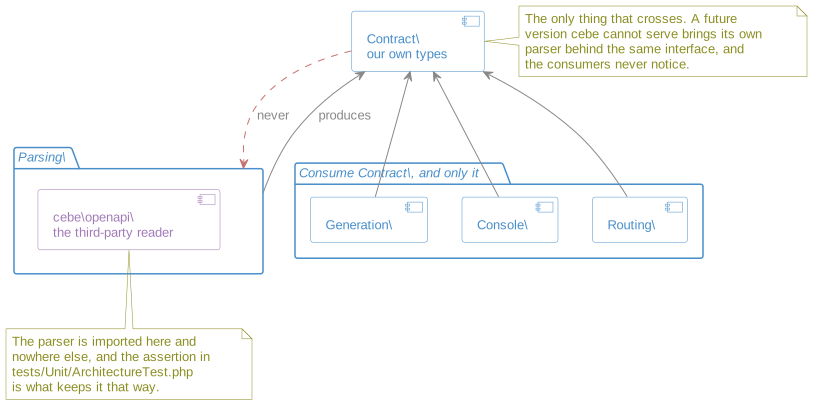
The namespace boundaries.
The table says what each namespace owns; the picture says which way the dependency runs, which is what the arrangement exists for. One box contains the third-party library, one type of thing leaves it, and the arrow back into Parsing\ is the one nothing may draw.
Inside Parsing\, Guards\ holds the checks that can refuse to load a document: the reference cycle detector and the remote reference guard. It is expected to stay small by design: this doctrine sends almost every check to the doctor, which reports, and keeps here only what makes loading impossible or unsafe. Both of the current members earn that: one guards a failure the parser does not survive, the other a request it would make on a stranger's behalf. The remaining guard already implied by a decision elsewhere is the check that vendored references are present, which frozen by default requires.
The architecture test in tests/Unit/ArchitectureTest.php asserts it directly:
arch('the OpenAPI parser stays inside Parsing')
    ->expect('cebe\openapi')
    ->toOnlyBeUsedIn('Gcob\LaraSpecFirst\Parsing');
That is stricter than forbidding the parser to the request path, and simpler: there is one boundary to state rather than a list of namespaces to keep current as the package grows.
And it is binding now rather than in principle. OperationExtractor imports the parser, so the assertion has something to constrain: it was written while the room was still empty, which cost nothing, and it started doing work the day the first use cebe\openapi\… was added. Retrofitting it after the imports existed would have cost an audit.
Honest about what it proves. The assertion reads imports, not data. Importing a cebe\openapi\ class outside Parsing\ fails it; handing the same content across the boundary as a plain array does not. The boundary is only as real as the types crossing it, which is why Parsing\ returns Contract\ objects and why a second assertion forbids Contract\ from knowing anything about the layer that produced it.
Parser caveats
Every row below was verified against the vendored devizzent/cebe-php-openapi. These are not criticisms of the library. It is a low-level reader and it says so. They are the constraints our layer has to compensate for.
Line numbers cite the versions in composer.lock at the time of writing, including laravel/framework 13.x for the Laravel constraints below. The behavior is what matters and it holds across the supported range; the line numbers may not.
| Caveat | Evidence | What it means for us |
|---|---|---|
validate() is structural only. Validation against the OpenAPI JSON Schema exists only in the CLI tool, not in the library API. | Parser README.md, OpenApi.php:86 | We cannot rely on the parser to reject a malformed spec. Rejecting bad documents is our job, and it is a headline feature of a Spec-First package. |
| Unknown properties are kept as raw PHP arrays, silently. | SpecBaseObject.php:142-144 | 3.1 JSON Schema keywords (const, prefixItems, $defs, if/then/else, patternProperties, dependentSchemas, unevaluatedProperties, contentMediaType) survive, but never as Schema objects, and any $ref inside them is never resolved. The most dangerous caveat on this page, because nothing fails: you get a value, it is just wrong. It will bite the Faker mocker in Phase 2 hardest. |
type is declared as a string but 3.1 arrays pass through unvalidated. | Schema.php:92 | Our code must accept string|array everywhere it touches a type, or normalize it at the boundary. |
exclusiveMinimum / exclusiveMaximum accept both booleans and numbers with no version check. | Schema.php:155-161 | The same property means different things depending on the document version. Only the strategy should ever see the raw form. |
A Path Item's $ref is special-cased and is not a normal Reference. | PathItem.php:73-78 | Path-level $ref needs its own handling in the router. |
Remote $ref by URL is resolved transparently, by calling file_get_contents() on it. | ReferenceContext.php:217 | Network I/O and an SSRF surface, handed to whoever wrote the document. Refused before the parser sees it; see remote references. |
paths is not required for 3.1 documents. | OpenApi.php:91 | Zero routes is a valid outcome, not an error. |
A pure $ref cycle exhausts memory instead of raising. | Verified: A: {$ref: B} / B: {$ref: A} under RESOLVE_MODE_ALL dies in JsonPointer.php:108 with Allowed memory size exhausted | The parser does carry cycle checks (Reference.php:324,330), but this shape recurses past them. A malformed document takes the process down rather than producing a diagnostic: the one failure mode the doctor cannot report on, because it never gets to return. Detecting $ref cycles is our job, before the document reaches the parser. An ordinary recursive schema is fine; the two are different things. |
components.pathItems is not modelled at all. | Verified: Components::attributes() lists nine keys and pathItems is not among them | A 3.1 document reusing a Path Item through #/components/pathItems/… resolves to a plain value, ends up with no operations, and no error, so the endpoint disappears in silence, which is the one outcome this package must never produce. Refused where it is read, naming the two forms that do work: a $ref to another path, and a $ref to another file. Both verified. |
A $ref whose JSON pointer lands inside data exhausts memory the same way a pure cycle does. | Verified: tests/Fixtures/ref-inside-example.yaml and tests/Fixtures/example-object-value.yaml, each once accepted by ReferenceCycleDetector and each dying under OperationExtractor::parse() with Allowed memory size exhausted, Reference.php:246 / Reference.php:328 recursing without ever reaching a schema | A second way into the same failure as the row above, and the one a rule about key names cannot see: #/components/schemas/A/example is a legal pointer, example is legitimately data and is not walked, so no $ref-shaped node appears anywhere in the chain the guard collects. Only the parser, resolving the pointer against the already-built object tree, finds the $ref sitting inside that data and loops on it. Guarded against: the guard now follows a reference into the position it points at, which is the one moment a literal becomes specification. Both documents raise a cycle fault today, and tests/Conformance/KnownParserBugsTest.php keeps its child process to pin the other half, that they no longer take the interpreter down, the same way tests/Support/extract.php and the "Subprocess assertions" row in stack.md describe. |
What we depend on the parser for
Three of the caveats above are not inconveniences, they are failures with no symptom: two shapes of a pure $ref cycle take the process down, and components.pathItems loses an endpoint without a word. All three are guarded against, and all three were found within days of first use, on a surface no wider than paths and references. That is worth writing down honestly rather than discovering again later, and the cycle shape found through the conformance suite itself, rather than through production use, is the clearest argument yet for why that suite exists.
The exposure is contained, since cebe\openapi\ may appear in one namespace and an architecture test says so, but containment says where the dependency lives, not how much of it there is. This list is the second half: everything the package actually asks the parser to do. It is also, deliberately, the specification a replacement would have to meet.
| What we use it for | Why not ourselves |
|---|---|
Resolving $ref within a document | Mechanical, but easy to get subtly wrong. |
Resolving $ref into another file, relative to the referring file | The fiddly part: relative paths, nested documents, and the same target reached by two routes. |
| Traversing Path Items and their operations | Convenience only. We could walk the resolved array ourselves. |
Nothing else. Every further use is a decision to widen the exposure, and belongs in a pull request that says so.
Adding an interface in front of it would be premature today, and the reason is not that the dependency is fine. It is that we have used it for paths and references only. The place the object model is weakest is schemas, which is where 3.1 diverges most and where the parser keeps unknown keywords as raw arrays. An interface designed before that point would be shaped by the easy half of the problem, and an adapter shaped by the wrong half leaks the original's model anyway. The decision belongs at the moment schema normalization starts, with evidence from the hard part rather than a guess made from the easy one.
What the list above does in the meantime is make the answer cheap when that moment comes: three behaviours, two of which are one problem, is an estimate rather than an open question.
And the protection chosen instead is behavioural. An adapter guards against swapping a dependency; what has actually gone wrong twice is the dependency being wrong, which an interface would not have caught either time. So the answer is a conformance suite organized by equivalence class, which ends up serving the adapter's purpose as well, since a suite a replacement must pass is a stronger contract than an interface it must implement.
Reading a document
Before any rule above can apply, a file has to become a document. Five steps, and the order is the design rather than an implementation detail: each one is impossible before the one that precedes it, and the last two are impossible after.
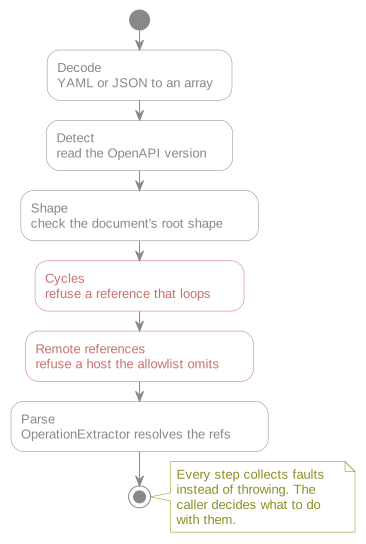
The reading pipeline. Five steps, and every one of them collects faults rather than throwing.
| Step | What it does | Why it sits there |
|---|---|---|
| Decode | YAML or JSON into an array. | Nothing can be decided about bytes. One code path serves both formats, because YAML 1.2 is a superset of JSON, and branching on the file extension would only add a way to reject a correctly written document for carrying the wrong suffix. |
| Detect | Read openapi, pick the strategy. | The version is a field inside the file, so dispatch cannot happen any earlier than this. |
| Shape | Check the root keys the version requires. | Needs the version to be known: paths is required at 3.0 and optional at 3.1, and that single difference is the whole reason this step is version-specific. |
| Cycles | Collect every $ref chain that never reaches content. | Last, and necessarily before the parser. See below. |
| Remote refs | Collect every $ref that would be fetched over the network. | Also before the parser: it resolves a URL by calling file_get_contents() on it (ReferenceContext.php:217), so by the time it raises, the request has been made and the document has already chosen where the application connects. |
Why the cycle check cannot move. A pure reference cycle is the one document fault the parser does not survive: it recurses past its own guards and exhausts memory rather than raising (parser caveats). Once the parser holds the document there is no exception left to catch and no process left to report with. So the check runs on the decoded array, before anything is handed over, and it cannot be folded into a wrapper around the parser, and whatever reads this pipeline's result must never hand a document carrying a cycle fault to the parser either, which is exactly what the pipeline's result guarantees rather than merely hopes for.
The pipeline never throws
Decode, detect and shape stop the read outright, since nothing can be known about the document at all without them, so the first fault among the three is the whole result. Cycles and remote references are different: a fault in one reference or one cycle says nothing about any other, so every one of them is collected into a list rather than only the first. SpecDocumentReader::read() returns that list either way, in a DocumentReadResult, and it never throws for a document fault.
The same is true one layer up. OperationExtractor::extract() collects a fault per operation, an unroutable verb, a malformed extension or an identity already claimed by an earlier one, and skips only that operation rather than aborting every one after it, returning what it could build alongside what it could not. Parsing\ReadOutcome::read() is the one place that assembles both into a single result: every operation that could be extracted, and every fault this read encountered, whether or not it stopped anything.
Nothing here decides what a fault means. Every caller does that for itself, from the same result. spec:build and spec:make still refuse the moment there is a single fault, exactly as before; the difference is that they now read that decision off ReadOutcome::$faults instead of catching a thrown SpecException. The doctor is a third caller reading the same result, which is the reason this pipeline stopped throwing in the first place: reporting every fault in one pass needs the fault list to exist, not to be replaced by whichever one happened to be thrown first.
One guarantee survives the change unconditionally: nothing unsafe is ever handed to the parser, whatever the fault list says. A cyclic document is still never extracted: ReadOutcome::read() skips calling OperationExtractor entirely the moment a CyclicReferenceException is among the collected faults, because detecting a cycle only ever reports it, it does not remove it from the document, and the parser cannot survive one regardless of how the fault is reported. A disallowed or unvendored remote reference is different in kind: RemoteReferenceGuard removes the $ref key the moment it cannot be resolved, so no network scheme string ever survives into what the parser sees, however many other faults the same document carries.
The key, and only the key. Blanking the whole Reference Object would be safe too, and it would rest on "the siblings of a $ref mean nothing", which is only true at 3.0. At 3.1 a Schema Object is JSON Schema 2020-12, so $ref sits beside applicable keywords, and a Path Item may carry parameters next to its own $ref: local properties, required or parameters the author wrote would be deleted along with the reference, and deleted silently. Keeping them costs a position that becomes invalid in its own right, a Response Object left with no description, surfacing as a parser fault instead of vanishing, which is the better of the two.
Removal still means the document describes less of the API than the file does, and that is what ReadOutcome::$neutralized says. spec:build and spec:make never meet it: they stop at the first fault and generate nothing. A caller that reports rather than refuses does, and owes its reader the distinction, because a routing table printed from a rewritten document is not the routing table the specification describes, and printing it beside the faults that rewrote it without saying so is the one way the result can mislead.
Nothing is written when a document could not be fully resolved. The rewrite is in memory for the root specification, and on disk for a vendored copy that itself named a reference, but only when the walk over that copy collected no fault of its own, and a vendored document that did fault is refused by its parent as well, so the reference pointing into it is removed rather than rewritten to a local path. Two properties depend on that pair: a read that fails leaves the repository untouched, and reading twice on unchanged inputs reports the same faults twice. See remote references.
The check is deliberately narrow, and each limit below is stated in a test rather than in a comment.
- It knows only what a single file can tell it. References into another file or over the network are skipped, since resolving them needs the vendored copies that a later step loads, so a cycle closing only across files is out of reach.
- A
$refinside a value is a value.example,default,enumandconstcarry data, and$refis a legal key name in data, and a specification describing an API that itself handles JSON Schema will contain one. The check does not descend into them, because mistaking a literal for a reference would turn away a valid contract, and this check refuses to load rather than reporting. - A value stops being a value the moment a reference points at it. The rule above says what is never walked into looking for references; it does not say what happens when a reference lands inside one, and the two are different questions. A Reference Object aimed at
#/components/schemas/A/exampleis specification, and the parser resolves it against the object tree it has already built, where it finds the$refsitting in that data and follows it like any other, which is how the memory exhaustion above is reached from a shape no rule about key names can see. So the check follows a target into data, and only a target: a document that merely carries a$refinside an example is untouched, and what is refused is a document that aims a reference at a position holding data, which was never a Schema, a Response or an Example Object to point at in the first place. Which key the data sits under makes no difference, so the three spellings,example, an Example Object'svalueand an item of the JSON Schemaexampleslist, are one rule and one refusal. - That refusal is wider than the parser's own failure surface, deliberately. Of the four data-carrying keys, three are load-bearing: a reference aimed into an
example, adefaultor anenumexhausts memory, verified at both 3.0 and 3.1 with the guard bypassed. A reference aimed into aconstdoes not, because the parser does not model the keyword and nothing resolves through it. It is refused all the same. The rule is a reference aimed at a position holding data is refused, not a reference aimed at a position holding data would otherwise kill the parser, and only the first of those is true for all four. Narrowing it to the three would tie this check to which keywords this particular parser happens to model, which is the kind of dependency on a defect the conformance suite exists to keep out ofsrc/. examplesis two things wearing one name, and the shape decides. The JSON Schema keyword is a list of literal values; the OpenAPI field of the same name, on Components, a Media Type Object or a Parameter, is a map of Example Objects, and an Example Object may be a Reference Object. The list is data and is skipped; the map is specification and is followed. Getting this wrong in the permissive direction would hide a cycle on precisely the shape the parser dies on, so it is not a case where the forgiving choice is the safe one.- Inside that map, each Example Object's
valueis data and is not followed. It is the one place where meaning comes from position rather than from a name:valuecannot be treated as data everywhere, becauseproperties: {value: {…}}is an ordinary schema. It matters because 3.1 recommends this long form over theexamplekeyword, so it is the shape a specification whose examples are themselves JSON Schema documents will actually use. - The list of data-carrying keys reasons about names, never about positions. A schema property actually named
default,example,enumorconstis a Schema Object and is not walked into. A reference aimed at one is caught all the same, by the rule above, which no longer depends on the name a position was reached through; what is still missed is a cycle closing entirely inside such a property with nothing pointing at it from outside. A false negative, and the harmless direction, but real. - A reference aimed at its own ancestor is not caught, because chains are compared pointer by pointer rather than by containment. Another false negative, and harmless for the same reason.
What comes out is narrow on purpose. The result says the document may be parsed, not that it is correct. It has not been validated against the OpenAPI schema, no $ref has been resolved, and the 3.0 and 3.1 spellings of the same idea are both still present exactly as written. Normalizing them for the package's own use happens after this step, and reporting what is wrong with the contents is the doctor's job. Refusing to load and reporting a fault are different jobs, and only the first one happens here.
Where that normalizing lives has two answers, one per tense, and the difference is worth marking rather than leaving a reader to reconcile. Today OperationExtractor produces the normalized Contract\ types on its own, and a strategy is consulted only to reject a root shape its version forbids. By design, every version-specific part of that interpretation belongs to the strategy, which is what the seam table states. Those are a sequencing gap rather than a disagreement: there is nothing version-specific to delegate until schema normalization exists, and that is Phase 2. Nothing downstream can tell which of the two is answering, which is the property the seam exists to protect in the first place.
Laravel constraints we do not fight
This package is a layer built on Laravel, not a replacement for its router. Where Laravel's model and OpenAPI's model disagree, the framework wins and we document the consequence. Working around the router to honor an exotic corner of the specification buys one feature and pays for it with every future Laravel upgrade.
That is a deliberate trade, and it is the reason some rows in the matrix say Rejected rather than Supported.
The spec file's order wins
/users/me and /users/{id} both match the request GET /users/me. OpenAPI defines no priority between them. Laravel resolves the first route registered. Rather than invent a sorting rule and hide it, routes are registered in document order, and the document order decides.
This is rule 3 in action: put the specific path above the templated one in your YAML, and it wins. The alternative, sorting literal segments ahead of templated ones, is defensible, but it means a consumer reading their own spec top to bottom cannot predict their own routing. An opinion you can see beats a heuristic you cannot.
The cost is stated plainly: reordering keys in a spec file can change routing behavior. That is a documented property of this package, not a bug report.
trace cannot be routed
Illuminate\Routing\Router::$verbs is GET, HEAD, POST, PUT, PATCH, DELETE, OPTIONS (Router.php:136). There is no TRACE. The parser accepts trace on a Path Item (PathItem.php:60), so a valid document can contain an operation Laravel cannot register.
Per the rule above, we do not work around the router. The operation is Rejected.
Shipped as the whole document failing, which is the honest half of the choice below and the one that needed no new mechanism: Contract\HttpMethod has no trace case, so the reader refuses the document and names the path.
Open: whether that stays absolute, or the operation alone is refused while the rest of the document still loads. The second is friendlier, and it needs somewhere for the refusal to be reported rather than thrown, which is the doctor, and the reason this is still open rather than decided by what shipped.
Parameter names are a contract
OpenAPI puts almost no constraint on a path parameter's name. {user-id}, {user.id} and {a_very_long_and_descriptive_parameter_name} are all legal. The router underneath Laravel is far narrower, and it does not fail politely.
What actually happens. Laravel compiles its routes through Symfony's compiler, which finds placeholders with #\{(!)?([\w\x80-\xFF]+)\}# (vendor/symfony/routing/RouteCompiler.php:118). \w is [A-Za-z0-9_], so {user-id} is not recognized as a placeholder at all: it stays literal text, and the route matches only a URL containing the characters {user-id}. No exception, no warning, an endpoint that silently 404s forever.
It gets worse in a specific way. Laravel's own Route::compileParameterNames() uses /\{(.*?)\}/ (vendor/laravel/framework/src/Illuminate/Routing/Route.php:535), which accepts anything. The framework's introspection and the framework's matcher disagree: parameterNames() reports user-id as a parameter of a route that can never bind it. Anything reasoning about the route, including our own doctor if it asked Laravel instead of the spec, would be told a comfortable lie.
And a hard ceiling nobody expects: a placeholder longer than 32 characters throws a DomainException from the same compiler (RouteCompiler.php:145). OpenAPI has no such limit, so a descriptive parameter name is a crash rather than a mismatch.
Given that, the hard parts were never in the conversion:
- The result is public API. The converted name appears in controller method signatures and in route model binding. Changing the convention later is a major release under rule 4.
- Conversion is not injective.
{user-id}and{user.id}in the same path both reduce touser_id. A collision must be an error, not a last-writer-wins. - The mapping has to survive the round trip. Reading a parameter back out of the request, and validating it against the spec, both need the original OpenAPI name. The two names have to be kept side by side, not converted and forgotten.
Leaning: reject, do not convert. Rule 3 and the position that API design is a skill point the same way. A build that refuses {user-id} and says rename this parameter to user_id in your specification is teaching a real constraint of the platform, once, at build time. A build that silently converts is maintaining a shadow naming scheme forever, and the developer still meets it the first time they read a generated signature. The 32-character ceiling is not negotiable either way and must be checked before the route is ever compiled.
Open: whether that rejection is absolute or has an escape hatch for specs the consumer does not own, the case acknowledgement exists for.
Still to discuss
The following were raised in analysis and are not yet reviewed. They are listed so nothing is lost, not because they are decided:
- Several parameters in one path segment:
/files/{name}.{ext}is legal OpenAPI and fragile in Laravel. servers, including path-level and operation-level overrides and server variables withenumanddefault: what becomes the route prefix.operationId: optional in the specification, not guaranteed unique, not guaranteed to be a valid PHP identifier, and it is what names the generated controller and method. Public API surface. The naming and rename questions are now answered ingenerated-file-anatomy.md; what remains here is how a missing or unusableoperationIdis reported.php artisan route:cache[Controller::class, 'routeAction']pair of plain strings, and a test runs the real command over a generated tree, then requires the cache file it wrote and checks the routes come back. The provider loads the file throughloadRoutesFrom(), so a cached application skips it as it should.webhooks(3.1) andcallbacks: not routes on this server.HEADandOPTIONS: Laravel handles HEAD for GET automatically, so an explicitheadoperation conflicts.- Phase 2 territory:
styleandexplode,deepObject,multipart/form-datawithencoding, multi-media-type content negotiation,discriminator,links,xml.
The support matrix
Every row is provisional. Open means the discussion has not happened; the other values are current intent for the first release, not shipped behavior.
Document
| Construct | Level | Note |
|---|---|---|
openapi 3.0.x | Supported | Dispatches to the 3.0 strategy. |
openapi 3.1.x | Supported | Dispatches to the 3.1 strategy. |
| Any other version | Rejected | Including 2.x. Convert before adopting. |
info, externalDocs | Out of scope | Documentation metadata with no routing effect. info.version becomes load-bearing only for breaking-change enforcement. |
tags | Partial | No routing effect, but they are the author's own grouping of their contract, and the package reuses it rather than inventing one, see scaffolding output. |
jsonSchemaDialect (3.1) | Open | Only the default dialect is realistically honorable. |
servers | Open | See still to discuss. |
security (root) | Open | Not yet decided, and the consequence is worth stating: the root block itself is not read into anything the package keeps. An operation's own security, absent, empty or a list, is recorded, but what an absent one actually inherits is not, so changing or removing the root security block silently changes what every inheriting operation requires, with nothing in Contract\ reflecting it. The doctor says that much and no more: one line naming that the block exists and is not read, rather than a list of operations whose requirements nothing resolved. |
webhooks (3.1) | Open | |
x- extensions | Out of scope | Preserved by the parser and readable, but the package acts on none of them, except the ones it defines itself, on the rows beneath. |
x-audience, x-lifecycle, x-sunset | Partial | The lifecycle extensions this package defines. Read with defaults resolved and an unrecognized value refused rather than silently taken as the default. The doctor's rules over them run: a deprecation with no removal date, a date passed or unreadable, the beta listing and the protection report. The breaking-change enforcement x-lifecycle gates is not built yet. Rules: lifecycle. |
x-controller | Supported | Names the class of an operation's custom controller, which is also what makes that operation customizable at all: without it the generated controller is final. Rules: controllers. |
x-model | Partial | Names the Eloquent model an operation reads and writes. It supplies the generated controller's default query, its route-model-binding type hint, and the CRUD default the build emits. Rules: controllers. |
Paths and operations
| Construct | Level | Note |
|---|---|---|
paths | Supported | The source of every registered route. |
Path templating {param} | Partial | Conforming names only, pending the naming decision. |
| Several parameters in one segment | Open | |
Path Item $ref | Partial | A reference to another path or to another file resolves. A reference into components.pathItems (3.1) is refused, because the parser drops it in silence. |
get, post, put, patch, delete | Supported | |
options | Open | Conflicts with Laravel's own handling. |
head | Open | Laravel derives HEAD from GET automatically. |
trace | Rejected | Not routable. |
| Route ordering | Supported | Document order wins. |
operationId | Partial | Names the generated controller and method. Required on public + stable operations; elsewhere the method and path stand in for it. |
deprecated | Partial | No effect on routing, but it is the authoritative lifecycle state and it gates the x-sunset rule. See lifecycle. |
callbacks | Open |
Parameters, bodies, responses
| Construct | Level | Note |
|---|---|---|
parameters (path) | Partial | Needed for routing. Validation is Phase 2. |
parameters (query, header, cookie) | Deferred | No routing effect. Phase 2 for validation. |
style, explode, allowReserved, deepObject | Open | Phase 2. |
requestBody | Deferred | Phase 2. |
responses | Deferred | Phase 2, and the input to the Faker mocker. |
links | Open | |
Media type encoding | Open | Phase 2. |
Schemas
| Construct | Level | Note |
|---|---|---|
| Core JSON Schema subset shared by 3.0 and 3.1 | Open | Phase 2 defines how far this goes. |
nullable / type: [..., "null"] | Open | Normalized by the strategy; the normal form is not chosen. |
allOf, oneOf, anyOf, not | Open | |
discriminator, xml | Open | |
3.1-only keywords (const, prefixItems, $defs, if/then/else, patternProperties, dependentSchemas, unevaluatedProperties, contentMediaType) | Open | Blocked on a parser caveat: the parser hands these back as raw arrays with unresolved $ref. Whatever we decide, it cannot be "read them from cebe and hope". |
References and security
| Construct | Level | Note |
|---|---|---|
Local $ref within the document | Supported | |
$ref to another local file | Supported | Multi-file specs are a Phase 1 goal. |
Remote $ref by URL | Rejected | Allowlisted hosts only, and the allowlist is empty until a project declares one, which it cannot yet, so every remote reference is refused today. Refused before the parser sees it, since resolving one means fetching it. |
Recursive schema ($ref back to an ancestor) | Supported | A self-referential schema, a tree, a comment thread or nested categories, resolves. Verified: under RESOLVE_MODE_ALL the parser walks it on demand without limit or error; under RESOLVE_MODE_INLINE the inner $ref stays a Reference object. |
Pure $ref cycle (A → B → A) | Rejected | A reference chain pointing only at other references and looping back. The parser does not fail gracefully here, see parser caveats. The doctor must catch it before the parser is handed the document. |
$dynamicRef, $dynamicAnchor, $recursiveRef, $recursiveAnchor | Rejected | JSON Schema 2019-09/2020-12 dynamic-scope resolution, reachable only in 3.1. A different feature from a recursive schema, and rare outside meta-schemas. Rejected with a message that says which of the two you probably meant. |
securitySchemes and security | Partial | An operation's own security distinguishes inheriting the document's requirements from explicitly requiring nothing, so that removing it stays visible. How that distinction is tracked is undecided. Read and reported, never applied: the doctor names every operation that declares a requirement, individually, on every run, because this phase registers its route with no authorization check behind it. Mapping it to middleware is decided: security.md. |
Changing this document
The rules in documentation.md apply, plus two specific to this file:
- A row changes in the same commit as the behavior it describes. This matrix is the definition of done for any change to what the package accepts from a spec. A behavior change that leaves the matrix stale is an incomplete change, exactly as
AGENTS.mdstates. - State the release impact when moving a row. Rule 4 makes direction meaningful: say whether the move is minor or major, in the commit message.