Remote References
In brief
- A
$refpointing at a URL is refused unless you named its host in the allowlist, which ships empty.spec:build --update-refsfetches an allowed reference once and commits the copy. Every later build reads that copy, never the network.- Those copies are committed and there is no lock file, because git is the lock.
- A fetched document that names a reference of its own is fetched too, and the allowlist is checked again at every hop.
Mostly intent, marked per section. Items marked
Openare undecided.Shipped: the setting and everything it means.
lara-spec-first.remote_references.allowed_hostsdefaults to empty, and every remote reference is refused before the parser can fetch it: an empty allowlist still means no remote references at all. Naming a host now does what the setting always promised:spec:build --update-refsfetches it once, commits the copy underremote_references.vendor_path, and every build after that, with or without the flag, resolves the reference against that committed copy. A missing copy is a build error naming the flag to run, never an implicit fetch. See the mechanism for how this holds without touchingcebe\openapi\at all.
What a remote reference is
# openapi.yaml
components:
    schemas:
        User:
            $ref: https://schemas.example.com/user.yaml
Every other input to the build sits in the repository. That one does not, and this document owns what the package does about the difference.
A document that can pull a schema over HTTP turns a config file into a network client running with the application's credentials and network position. Two problems, not one:
- Security. An untrusted or compromised spec reaches whatever the application server can reach: internal services, cloud metadata endpoints. The spec file is usually reviewed like documentation, not like code that makes outbound requests.
- Availability. A remote host that is slow or down becomes a boot failure for an application that has nothing to do with it.
The allowlist ships empty
Remote $ref targets resolve only from a set of domains the consuming application named:
// config/lara-spec-first.php, published with --tag=lara-spec-first-config
'remote_references' => [
    // No host, therefore no remote reference.
    'allowed_hosts' => [],

    // A directory at the project root. Committed, never gitignored.
    'vendor_path' => 'openapi-external-refs',
],
An allowlist is the right shape because it is flexible where teams need it, an internal schema registry or a shared contract repository, and closed everywhere else. Empty by default means local files keep working, and a project that never uses remote $ref never meets this feature.
Four rules govern what happens at the boundary:
- A disallowed reference is an error, never a skip. A silently unresolved
$refis an unhonored contract, which rule 2 forbids.RemoteReferenceExceptionnames the offending reference and says vendoring it is the way in. - A missing vendored copy is an error naming the flag, never an implicit fetch.
MissingVendoredReferenceExceptionnames the reference, the vendored path it expected, andphp artisan spec:build --update-refs. "Unresolvable reference" is a support ticket; that triple is a fix. - Matching is on the host, exactly, case-insensitively. No wildcard subdomains, no partial matches:
evil-example.commust never satisfy an entry forexample.com. Case is not part of the scope this rule protects, since DNS does not see one, soSchemas.Example.COMandschemas.example.comare one host, matched and vendored to one directory either way. Checked again at every hop a vendored document itself references, see transitive fetching below. - A redirect is refused, never followed. The allowlist checks the host written in the document; a client that follows a
3xxresponse fetches whatever it names instead, which is the one thing this feature cannot let happen silently.spec:build --update-refsdisables redirects entirely and reports one naming theLocationit pointed at. A reference that moved is a reference to rewrite in the document, not one to follow through automatically.
Status: shipped. Both keys are live, and spec:build --update-refs is the one command that reaches the network.
The config merges deeply
The package's defaults are merged deeply underneath whatever an application published, by ConfigurationMerger rather than by Laravel's helper. Laravel's own mergeConfigFrom() merges one level, which is right for a flat file and wrong for a nested one: an application that publishes this file and edits a single nested value replaces the whole sub-array, so every key added to that section in a later release arrives missing. A published config that rots a little with each upgrade, silently.
Lists are the exception and are replaced wholesale, because merging allowed_hosts element by element would make a host impossible to remove, which is the opposite of what a setting named after trust should do.
A reference is a dependency
Repeated network calls for the same reference are waste, so something has to hold the fetched document. The word for that something is not cache, and the word is the design.
A cache is expendable by definition. You may clear it at any time, it may expire on its own, and nothing about your application changes when it does: that is the contract of the word. None of that is true here. A remote $ref supplies part of your API contract, so dropping it leaves your application unable to describe, route, or validate what it serves. A remote reference is a dependency, in the full sense the word carries in this ecosystem, and it should be handled the way dependencies are: a vendored copy under version control, and an explicit act to change it.
Why not a cache
Two things follow immediately, and each kills a config option that looked reasonable:
- No duration. A TTL means the contract can change at a moment nobody chose. Some Tuesday at 14:03 an entry expires, the upstream document has moved on, and the application serves a different contract than it did a minute earlier, with nothing deployed, committed or reviewed. A contract changes when someone ships a change, not when a timer fires. A source of truth that varies with wall-clock time is not a source of truth. No dependency manager resolves your dependencies again because an hour passed, and neither does this.
- No cache store. Routes are registered while the framework boots, so whatever the registration reads has to be available before the container is warm. Depending on Redis to know which routes exist is a boot-time network dependency in the request path, for data that never changes between deploys, and a shared store lets two servers in the same release disagree about the contract, which is precisely the failure a spec exists to prevent.
Git is the lock file
The dependency analogy suggests a lock file. It should not be taken, and working out why sharpens the whole design.
A lock file exists to pin something mutable to something exact: a version range to a resolved version, a resolved version to a content hash. Here there is no version to pin. A $ref is a URL, and the only thing that could be recorded is a hash of bytes we are already about to store on disk, so the lock would restate, less usefully, what the vendored copy already is.
Less usefully, because of the review argument. A lock file diff says a hash changed. A vendored document diff says this response gained a required field. For an API contract, the second is the entire value, and only committed copies produce it. Git already content-addresses every file, so the integrity check the lock was there to provide is a property of the repository rather than something to reimplement.
The vendored copies are committed and there is no lock file. Two consequences to design around:
- The local path must encode where the document came from, since nothing else records provenance. A layout mirroring host and path, one directory per host with the URL's path beneath it, is self-documenting, greppable, and reviewable. Fetching from the same URL twice must land in the same place, or the whole scheme leaks.
- Detecting local tampering requires a refetch. Without a recorded hash, a hand-edited vendored copy is caught by code review rather than by the tool. That is an honest trade, not an oversight: the edit does show up in a diff, and re-fetching is what the update path does anyway.
A query string is folded into the filename via a short stable hash rather than supported literally, a narrow answer rather than a general one. Still open: very long paths and case-insensitive filesystems both complicate a path-mirroring layout further than this iteration solves.
Borrowing the dependency-manager shape
The parts of the pattern worth taking, and only these:
| Piece | What it does here |
|---|---|
| Vendored copies, committed | The fetched documents, on disk, in version control. Once they exist, boot resolves everything locally and the runtime never touches the network: not on a miss, not on the first request after a restart, never, because there is no lookup to miss. Their diffs are how a change to your API contract shows up in a pull request instead of in production. |
| Frozen by default | The build never reaches the network on its own. A fresh clone builds offline; a missing vendored copy is an error naming the flag to run, never an implicit fetch. |
| Fetching is one explicit act | Adding a reference and refreshing one are both deliberate, flagged operations, because both can change your contract. See the build. |
| Integrity by repository | Upstream changed under you? The refetch produces a diff, in a commit, in a review. A remote $ref is third-party content that shapes your public API surface, and treating it as untrusted input is the lesson every package ecosystem learned the expensive way, and git gives us that property without a mechanism of our own. |
The allowlist still governs every fetch, but its threat model shrinks to almost nothing: outbound requests now happen only inside an explicit, human- or CI-triggered operation, never in a request.
Where the analogy stops
We are not building a dependency manager, and the borrowed vocabulary must not drag in the rest of it:
- No version constraints, no resolution, no solver. A
$refis a URL, not a package with a version range. There is nothing to negotiate and no conflicts to resolve. - No registry, and nothing to publish.
- No lock file, since git already is one.
- One divergence, deliberate: the vendored copies are committed. Composer can leave
vendor/out of version control because Packagist guarantees a published version is immutable. Nothing guarantees that abouthttps://example.com/schemas/user.yaml, which can change or vanish tomorrow. Committing the copies is what makes an old release still deployable, and it is why no lock file is needed.
Decided: the vendored directory is named by remote_references.vendor_path, and the refetch flag is spec:build --update-refs, one flag for both adding a missing reference and refreshing one already vendored rather than two. Both are public API surface under rule 4.
Transitive references are vendored too
Followed, not refused at depth one. A document spec:build --update-refs just fetched is walked the same way the root specification is: every $ref it names is checked against the allowlist and vendored in turn, so a schema registry that splits its documents across several files works exactly as it would if none of them were remote.
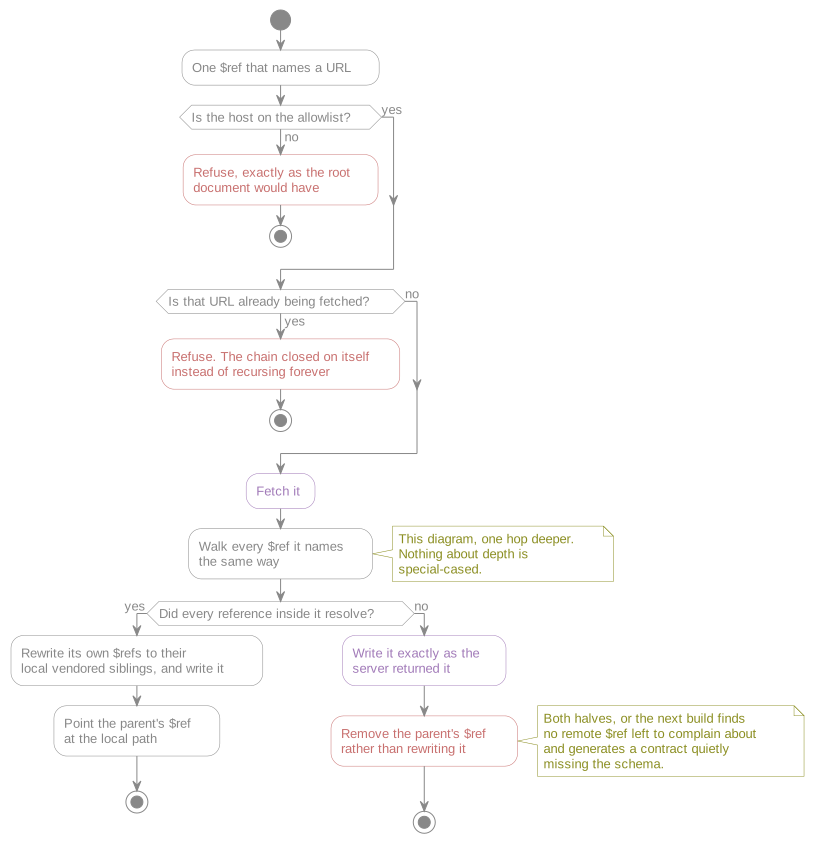
One reference, walked. The recursion is the diagram calling itself.
The two endings are the part worth the second look: the same walk either points the parent at a local path, or leaves upstream's bytes on disk and takes the parent's reference away.
The allowlist applies again at every hop: a vendored document naming a host nobody allowed refuses exactly like the root document would, and a chain of references that closes back on a URL already being fetched raises rather than recursing forever. Nothing about depth is special-cased, and the same check run again is what "at every hop" means.
One consequence worth naming: the committed copy of a document that itself named a remote reference is not byte-for-byte what the server returned. Its own $ref values are rewritten to point at their local vendored siblings before it is written to disk, for the same reason the top-level reference is rewritten. What a reviewer reads in that diff is still upstream's content; only a URL that would otherwise reach the network again on every rebuild becomes a path that already has.
Why a refused copy keeps its URL
A vendored copy the walk refused something in is left on disk exactly as it was fetched, and the reference pointing into it is removed from the document that named it rather than rewritten to a local path. Both halves matter and neither works alone:
- Not rewritten, because the walk has already removed the offending
$reffrom the in-memory copy, and writing that back would erase the evidence of the fault from the file the next read starts from. The realistic case is a fresh clone where a transitive vendored copy was never committed: the first build says to run--update-refs, and if the parent file had been rewritten in the meantime, a second plain build would find no remote$refleft to complain about, exit successfully, and generate a contract quietly missing the schema that reference pointed at. So: a build that fails writes nothing, and building twice on unchanged inputs reports the same faults twice. - Not linked to, because keeping the original bytes means that file still names a URL, and the parser resolves a local
$refby opening the file itself, so a parent rewritten to point at it would handcebe\openapi\the very reference the walk refused, one hop later.
A file --update-refs fetched on the way there does stay on disk. That is upstream's own bytes, exactly what the flag was asked to vendor, and the next build walks it again and reports the same fault from it.
The parser never sees a URL
Nothing above would work if cebe\openapi\, the OpenAPI parser this package wraps, ever met a $ref naming a URL, because it resolves one by calling file_get_contents() on it directly. Two properties of how the parser is already used are what make rewriting the reference enough, with no change to the parser or to how it is called:
- The parser is handed the array this package already decoded, never asked to re-read the file.
OperationExtractor::parse()builds its object model from$document->raw, the same arraySpecDocumentReader's five-step pipeline produced, rather than reopening the specification from disk. So a$refrewritten during step 5 is exactly what the parser receives; there is no second read of the original bytes for a rewrite to lose a race against. - A relative reference is resolved against the document that names it, recursively.
ReferenceContextresolves each$refrelative to the file its containing document was read from, and when the parser follows a reference into another file, it resolves that file's own references the same way, relative to that file. This is not new behaviour added for vendoring: it is what already lets a specification split across several local files work today.
Put together: once every $ref naming a URL has been rewritten to a path relative to the document that names it, the root specification or a vendored file that named another vendored file, the result is indistinguishable from an ordinary local, multi-file specification. The parser was never taught about vendoring; it simply never encounters anything to fetch.
Vendoring is part of the build
Vendoring makes the inputs local. Turning those inputs into routes, controllers and validation is a separate job, and both belong to the same command, see code-generation/index.md. Do not conflate the two: vendoring alone already guarantees no network at boot, whatever the build does afterwards.
What is settled here regardless: the doctor reads, it never writes. It is read-only by contract, and its report names which sources it read, because a doctor that silently checks something other than what runs is worse than no doctor.