Card Management
In brief
- A card is a change that can merge into
mainon its own and leave it stable, tested and documented.- A lot exists before its cards, as a lot card in
Backlog, and its cards are cut when it opens: aBacklogcard is a sketch, aTodocard is a specification, and moving one between them is the rewrite rather than a drag.- A
Todocard has nothing left open: no assumption, no discovery, no open decision. What was settled is written in itsDecisions, and that is what makes it ready for an agent.- Size is a target, not a measurement: a pull request somebody reviews in one sitting. Under roughly four files, ask whether it is a card at all; past roughly four hundred added lines, ask what else got in.
- Three tests, in the order they catch things: does it cost more to file than to do, does its title need "and", does one of its decisions take work to settle. A decision that only needs an answer is settled before
Todoinstead.- Adjacent work found while a card is open is done inside it, in its own commit, not filed as a card of its own. Clean scope protects the reviewer, so the split is decided once, when the pull request opens.
- A card is a hypothesis. If its title is still true the scope simply grew; if it is not, the card is rewritten. The divergence is written in the pull request, and only when the original plan was wrong.
- The template is the issue form. This file is where its reasoning lives.
Statusmoves with the work;PhaseandKindare set at triage andLotwhen that lot is cut. The board holds all four, and a card's body carries one only until it gets there.
Three lots have been cut so far, and each one needed a review to find the same two failures: a card small enough to be a checkbox on another one, and a card large enough to be a lot. This file exists so that the next lot does not pay for that review again.
A card is a vertical slice
A card is a change that can merge into main on its own and leave it stable, tested and documented. That is the whole definition, and everything below follows from it.
It is never "the emitter", then "its tests", then "its documentation". The three-places rule already forbids splitting those apart, so a card that proposes it is asking for permission to ship something incomplete. When a change is genuinely too large, split it the other way: the happy path first and the edge cases second, or one command flag at a time. Both leave each half shippable.
Cards are cut when the lot opens, not before
A lot exists from the day the phase is planned, as a card of its own sitting in Backlog. The cards inside it are written just before that lot opens. This file leans on the rule twice already, once to defer #40's split and once to explain a card with no Lot, so it is worth stating as a rule rather than leaving as an excuse.
The reason is that a card written six months early is written against a tree, a design and a set of decisions that have all moved by the time somebody picks it up. Lot 0 paid for that in full: its cards were written in one sitting before any of the work was understood, and every one of them had to be reworded mid-flight, not because the work changed but because the card had guessed at how the work would be described.
Which is what the Status column actually says: how settled a card is, not only where it sits. A Backlog card is a sketch. It records that something is coming and roughly what, and reading it as though it were settled is the mistake this rule prevents. A Todo card is a specification: its lot has been cut, so it was rewritten against the tree as it stands now.
Opening a lot starts with its own card, not with its cards. The lot card was sketched as early as any other, so it is questioned again first: what it assumed is checked, what it did not know is found out or turned into a Decision card, and whatever has gone stale since it was written is corrected. Only then does it move to Todo and are its cards cut, against decisions that hold today rather than the day the phase was planned.
Moving a card from Backlog to Todo is that rewrite, not a drag between columns. A sketch promoted without being rewritten is a specification nobody wrote, and it gets discovered mid-flight, which is exactly what Lot 0 cost. Deleting a sketch is the opposite overreaction: the intention it records is worth keeping. #40 is the standing example, known to be a lot rather than a card, and split when Lot 2 opens rather than today.
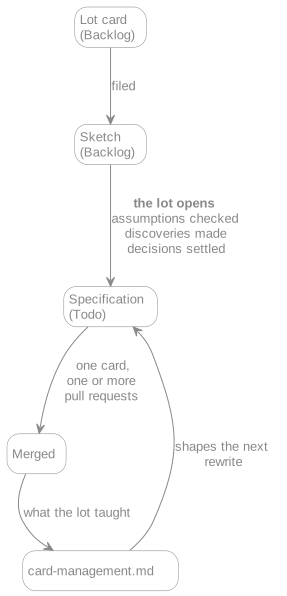
From the lot card to a merged card. The edge worth the picture is the one running backwards, from a finished lot to the next one's rewrite.
From a sketch to a card an agent can take
Two levels, the lot and then each of its cards, and the same three verbs at both. Assumptions are checked, discoveries are made, decisions are settled. What comes out at the end is a Todo card that has nothing left open, so that whoever codes it never has to come back with a question.
- The lot opens. Its lot card is questioned again, emptied of assumptions and discoveries, and moved to
Todo. Its cards are cut against it, plus aDecisioncard for each discovery that takes work. - A card is prepared. Its assumptions are checked against the code, each one ending as a permalink under
Where to look, a decision, or nothing. Its discoveries are made, by research or by a trial. - Its open decisions are settled. By whoever owns them, and written in its
Decisions. Checking a fact can be handed to anybody; deciding cannot. - It moves to
Todo. Nothing is left open, which is the only thing the column claims. - It is coded. Whoever starts it checks it again against the tree and reads its lot card, then works without coming back unless a decision has stopped holding.
None of these steps needs a particular tool or a particular kind of worker. A person can do all five, and an agent can do the second and the fifth; the third stays with whoever owns the decision.
One card at a time is the default. Working on several at once is decided case by case, when it is safe and when it is worth it, and it is not a rule in either direction. It is safe when two conditions hold:
- Everything in the card's
Ready whenis merged. A card whose blocker is still open is checked against a tree that is about to change under it. - It shares no file with a card already in progress. Two branches editing the same file meet in a conflict, and the second card's
Decisionswere checked against code the first one is rewriting.
When either is in doubt, the cards go one after the other. Preparing a card while another one is being coded is the same question: its assumptions are only as good as the tree they were checked against, which is why step five checks them again.
A finished lot owes one thing to the next
What it taught, written down where the next lot will read it. That place is What we have actually got wrong on this page, named with the card that produced the lesson. A lesson nobody wrote down is a feeling, and the next lot repeats it.
The lesson also says what the card template learned. The template changes one lot at a time: whatever a lot found missing, redundant or misleading in its cards is adjusted before the next lot opens, so each lot is cut with what the previous one taught rather than with what everybody remembers of it.
It is the one box in the lot card's Done when, and it is ticked either way. Either the lesson is written, or the lot card says plainly that nothing was learned. Silence is the only answer that does not close it. The lesson lands on a branch carrying the lot card's number, as docs/{lot card}/lot-N-lesson, the same way any other card branches.
Size is a target, not a measurement
This repository's own history cannot be the calibration, and it is worth saying why out loud. Phase 1 was written in very large pull requests: #12 changed 73 files and added 5,984 lines, #5 added 5,067, #16 added 4,174. Averaging that would enshrine exactly the habit this file exists to stop. The Lot 0 cards are the opposite sample and no more usable alone: four documentation changes, 4 to 31 files, 113 to 362 added lines. Both are ditches, not a road.
So the target is chosen rather than computed:
- A pull request somebody reviews in one sitting, without a pause. That is the real constraint. Everything below is a proxy for it.
- Under roughly four files touched, ask whether it is a card at all. It is usually a line in another card's
Done when. - Past roughly four hundred added lines, ask what else got in. Not a refusal, a question. The answer is usually a second card.
No measured range is published here as a norm. documentation.md already refuses a number in prose that an unrelated change can falsify, and a bracket computed from merged pull requests is precisely that: it moves on its own, and it would be wrong the week somebody lands one large refactor.
The three tests, in the order they catch things
Does the card cost more to file than to do? Then it is a line in another card's Done when.
Does its title need "and"? Then each verb is probably its own card.
Does one of its decisions take work to settle? Then it is a lot, not a card. This is the one generic advice misses, and the one this repository keeps hitting. A card whose Done when cannot be verified until somebody first researches, tries or writes something down is two pieces of work wearing one number, and the first piece is a Decision card the second waits on in Ready when.
A decision that only needs an answer does not make a lot. Somebody who can decide says which, and the answer goes into the card's Decisions before it reaches Todo. The test is what settling it costs, not how important it is: a public API choice somebody can make in a sentence is an answer, and a naming question nobody can answer before somebody has tried both names is work.
An interview is one way to run the third test
The third test is the hard one, because a body full of open decisions reads like a plan until somebody tries to verify it. One way to find them before writing the card is to be questioned about it: an agent that interrogates a design round by round surfaces the decisions nobody had noticed were still open, which is the same output the test is looking for. And that output has a place on the card: every question answered in the interview is a line in Decisions, and every one that turns out to need work is a Decision card of its own.
AIHero publishes skills that do this, grill-with-docs for something settleable in one session and wayfinder for a lot being cut. Those two names are search terms rather than links, since the pages documenting them move and a dead link here would be worse than a name somebody can look up. They are named here because they exist and they fit, not because anything depends on them: nothing in this repository invokes them, no command checks for them, and a card cut without one is not worse for it. What does not carry over is their paper trail. They write a CONTEXT.md glossary and ADRs under docs/adr/, and this project already answers both questions elsewhere, in documentation.md and in the Open rows of stack.md. Taking the interview and leaving the filing is the way to use them here.
Work that overflows a card is done inside it
A card is cut before the work starts, which means it is cut from outside the code. It will be wrong sometimes, and the two ways it goes wrong are worth separating, because they have different answers.
The first is adjacent work. Something small, obvious and clearly worth doing turns up while the card is open, and the reflex is to file it. Do it instead. Filing costs the writing, the rereading months later, the reload of a context that is loaded right now, a branch and a pull request, all to protect work that takes minutes. The context that makes the fix cheap is the thing the card would throw away.
Clean scope protects the reviewer, not the person writing the code. That is the whole reason the rule can be this loose: the constraint this file already publishes, a pull request somebody reviews in one sitting, starts applying the moment a reviewer exists. So it is enforced where it bites, when the pull request is opened, and nothing about it has to be decided while the work is moving.
The separate commit is what makes that possible, and it is the only thing asked during the work. It costs nothing, it does not interrupt anything, and it keeps the overflow extractable: work buried inside a larger commit cannot be split out later, so the decision at the end stops existing. A commit that says chore: or refactor: on a feature/ branch is already saying it is not the card, which is why no new marker is introduced here. The Conventional Commit type carries it, and a parallel vocabulary would drift from the one that already works.
When it stops being overflow
Three questions, and they are questions rather than limits. Each one has a clear answer in the moment and no useful answer in the abstract, which is why none of them is a count.
Does it finish in this session? The line is not small against large, it is finished against started. Started work asleep in a branch costs more than the card it was avoiding, because the context that justified skipping the card is gone by the time anybody looks at it again.
Does it need a decision you would not make alone? A design, a public API, a breaking change, none of which the card's Decisions settled. This is the third test arriving mid-flight rather than at triage: a decision that takes work to settle makes the work a lot, and noticing it late does not make it less of one. One that only needs an answer still needs it before anybody codes against it, which is the job of a card reaching Todo, not of the card already open.
Does it touch a migration or the published contract? Those carry a review cost that unplanned work does not pay, and the compatibility surface is a contract the moment the package is published.
Nothing here is a quota. An overflow that keeps growing is not caught by counting it, it is caught by one of the three questions above finally answering yes, and by the pull request getting harder to describe in a sentence. The person doing the work is the one who can see that, and this file gives them the questions rather than a number to obey.
Overflow that is not done is deferred work, and that rule already exists. When the answer to any of the three questions is yes and the card it belongs to is not open yet, what you leave behind is a marker carrying a card number, at the line where a future reader needs it. The notation, the rule and the limit that keeps markers from becoming noise are all in CONTRIBUTING.md, which is where they live because just check-markers reads this file and would flag the notation written out here as a marker of its own. Whether the marker is worth leaving at all is answered there too: only where the code is where somebody would need to know, since a marker that repeats what the card already says is noise.
The split is decided once, when the pull request opens
Read the branch's git log and decide there, not earlier. By then the work is done, the overflow is visible, and the reviewer the split protects finally exists. This is the same reason cards are cut when their lot opens: the decision is cheaper and better once the information exists.
A commit belongs in a pull request of its own when one of these is true.
- It touches a different area than the card. A different reviewer would be the right one, and bundling it means neither of them reviews their own half properly.
- It has to be revertable on its own. The risk profile is not the card's, so it should not share the card's fate.
- It is larger than the card it grew out of. That one is a diagnosis rather than a rule: it says the triage was wrong, and the split is the smaller half of what to do about it.
Otherwise it stays in the same pull request and the description says so. A reviewer reading "commits 3 and 4 also fix X, which the change needed" is better served than one who finds them unannounced.
Stacking pull requests on one another is available and is not required. It is worth knowing about, because it is what makes the first case above cost little: branch the second pull request on the first rather than on main, and each stays reviewable on its own. Whether the bookkeeping is worth it on a given change is the author's call, and on most changes it is not.
A card whose scope grew, and a card whose goal changed
A card is a hypothesis, not a contract. It was written against the tree and the understanding available before anybody opened the code, and finding out that it was wrong is the work succeeding, not the work going astray. This file already says as much about a Backlog sketch; the same holds for a Todo card once the work starts.
The question that separates the two cases is whether the title is still true.
- It is. The goal holds and the scope grew under it. Adjust the body and carry on. Nothing else happens, and nothing about the board changes.
- It is not. The card now tells two stories. Rewrite it whole, or close it and open one that says what the work actually is.
The failure to avoid is the hybrid: a card that keeps its original title and accumulates a second goal underneath. It reads as settled, it is not, and nobody can tell three months later which half the number refers to. Rewriting a card is already the ordinary move here, since promoting a sketch to a specification is a rewrite rather than a drag, so this asks for nothing the project does not already do.
Where the divergence gets written
In the pull request description, and only when there was one.
Not in the card: the card would be a third copy of what the commits and the description already carry, and three copies drift. Not in the template either, for the reason Out of scope was declined: a section that is always present is filled with "none" or with a restatement of the diff, and a template nobody completes stops being read. The card gets one line when it closes, not a running log.
What earns the space is why the original plan was wrong, not a list of what else got done. The diff already carries the list.
The card assumed the resolver handled nested
$ref. It did not, so commits 3 and 4 rework it, which is where the size of this pull request comes from.
That is worth reading. "Also touched the resolver, fixed two typos and added a test" is not: it is the diff, retyped.
And it compounds. Written down consistently, the reasons the plan was wrong are the one record nobody keeps and everybody needs: where this project's estimates break. A run of them says more about what to watch for in the next lot than any estimate would have.
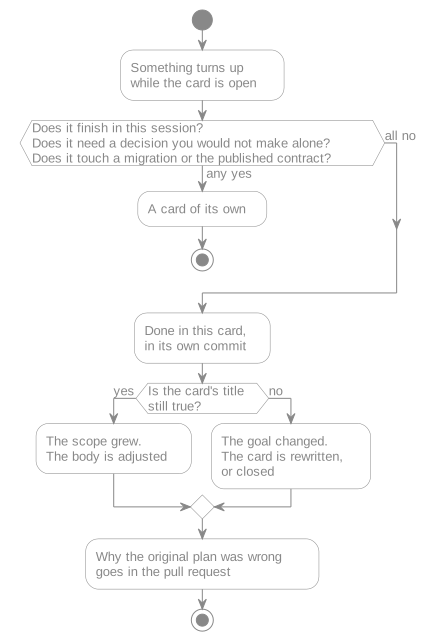
What happens to work that turns up while a card is open. The three questions are one gate rather than a checklist: any single yes ends it, and none of them outranks another.
What we have actually got wrong
Named with the cards that produced them, so that the lesson is checkable rather than asserted.
A card that says it "lands in the same change" as another one is a checkbox on that other one.#37 said exactly that in its own Ready when, and was folded into #34. The three-places rule had already made it impossible for #34 to ship without it.
A card that carries a decision, a reusable mechanism and an emitter at once is a lot.#40 carries the overrides.scan naming and recursion decision, the extends-based override discovery, and the factory emitter. Its split happens when Lot 2 opens rather than now: it blocks nothing today, and rewriting a card before its lot is cut is the same guessing this file exists to stop.
A card whose Done when names a file instead of a result cannot be verified by anybody who did not write it.#70 wrote scripts/check-open-questions.mjs, with two halves that fail differently; the file was renamed to check-markers.mjs while the card was open, and the box had to be reworded before it could be ticked rather than simply ticked. The work had not changed. Lot 1 was written the other way round, because of what that cost: generated.namespace is read, and its config block moves from STARTED to DONE survives any rename, since it describes what is true rather than what is called what.
The template, and what each kind of card drops
The template lives in the issue form, which is what GitHub offers when somebody opens an issue. This file carries its reasoning; the form carries its shape. When the two disagree, the form is what people actually fill in, so fix the form first and then say why here.
Eight sections, of which two only ever appear on a Backlog card and most of the rest are absent on any given one:
| Section | Carries | Dropped by |
|---|---|---|
Why | Two sentences: the problem, not the solution | Nobody |
Ready when | Card numbers that have to land first, and nothing else | Any card that nothing blocks |
Assumptions | What is believed and could be checked by reading the code or the docs | Every card, on reaching Todo |
Discovery | What is known not to be known, and needs research or a trial to find out | Every card, on reaching Todo |
Decisions | Settled decisions and their reasons, boundaries included | Any card that settled nothing |
Where to look | Permalinks, and no prose | Any card with nothing to point at |
Acceptance | One to three Gherkin scenarios | Every card but a Feature |
Done when | Only the delta on top of the three places and composer check | Nobody |
So a Todo Docs card with no blocker and nothing to settle is two sections, a Chore card is rarely more, and only a Feature card routinely carries six.
A card carries only the delta. Repeating the general definition of done on thirty cards is how it stops being read. Ready when replaces a ceremonial definition of ready: it holds card numbers, and it is deleted outright rather than left empty. A Decision card is done when the document stops saying Open, not when somebody has made up their mind, which is the same rule stack.md applies to its own Status column.
A Todo card has nothing left open
A Todo card carries no assumption, no discovery and no open decision. That is the whole definition of a card ready for an agent, and it is why no status was added for it: the column already says it. Rewriting a sketch into a specification is emptying the first two sections and settling what they turned up.
- An assumption is checked, by reading. It becomes a decision, a link under
Where to look, or it disappears because it was wrong. - A discovery is done, by trying. It becomes a decision when an answer is enough, or a
Decisioncard this one waits on inReady whenwhen it takes work, which is the third test. The line between the two sections is that one: an assumption is settled by reading the code or the docs, a discovery by research or a trial. Decisionsholds settled decisions only. A question still open there is the open decision the third test is about, filed under a heading that says it is not one.- A boundary is a decision. What the card does not do is written there, with the card that does it. That is where a boundary goes now, and it is still not an
Out of scopesection, for the reason below. - A decision that outlives the card goes into the documentation, in the file that owns its topic, and the card points at it under
Where to look. A card closes; the reason the package refuses something does not. Where to lookis permalinks and nothing else. A sentence beside a link is a second description of what the link already shows, and the two drift. Why a permalink rather than a path is further down.
The Decision kind and the Decisions section are not the same thing. A decision that takes work to settle becomes a card of kind Decision, which delivers a document that stops saying Open. A decision that only needs an answer becomes one line in the Decisions section of the card it settles. The first is work; the second is an answer written down.
And the card is checked again when the work starts. A Todo card was rewritten against the tree as it stood then, and other cards have merged since. Whoever starts it, a person or an agent, checks its Decisions and its Where to look against the tree as it stands now. A decision that no longer holds stops the work and goes back to whoever settled it: deciding it again on the way is the open decision the third test exists to catch, arriving where nobody will review it.
An Acceptance scenario is a sentence nothing runs
Nothing executes these scenarios, and nothing is meant to. There is no Behat and no Cucumber here; the test runner is Pest, and the tests a card ends up with are written in PHP like every other test in the tree. The fence says gherkin because it highlights, and because the three keywords force a shape a paragraph does not.
That shape is what the section is for. Given is a state, When is one trigger, and Then is something somebody could watch happen. A card that cannot fill those three lines has usually named a topic rather than described work, and the difference stays invisible until somebody tries to write the scenario. "Make security work" survives a Why paragraph; it does not survive a When.
What follows is what ten cards have done so far, not a specification. They are #34 through #44, all written in the same stretch of triage, and only one of them has shipped. So this is a record of a habit, and a young one, rather than a rule anybody agreed to:
- Two to three scenarios, which is what the table above already asks for.
- A command running is the commonest trigger, as in
When spec:build runsorWhen spec:doctor runs. A request being served is the other one, and #37 shows a third shape,When the conformance suite runs, for work whose subject is the test suite itself. - The last scenario is often the one where nothing happens. #43 ends on an operation that is not deprecated getting no header, #41 on an operation with no
x-modelstill answering 501, and #44 on no specification file being opened at runtime. The scope of a feature is as much where it stops as where it acts, and on those cards the negative scenario is the only place that says so. Scenario,Given,When,ThenandAndare the only keywords used. Not because the others are refused:Background,Examplesand tags exist to feed a runner, and nobody has yet had a reason to reach for them.
None of that is settled, and it should not read as though it were. Ten cards is early. If a scenario reads better another way, write it another way; if a shape turns out to be worth asking for, it can be written down then, once there is enough evidence to argue from. What this section commits to is the three keywords and the fact that nothing runs them. The rest is what we have happened to do.
A card cites a file as a permalink
A card cites a file or a line as a permalink pinned to a commit, never as a bare path. The issue form says so and this is why: a card is written against the tree as it stands today and started against the tree as it stands in six months. security.md:186 is a promise that the line has not moved, and nothing keeps that promise. A permalink names the commit, so it answers the same question forever, and it answers the one that actually matters, which is what we were looking at when we wrote the card rather than what is there now.
The same rule is why a card names the deferred-work marker it settles rather than describing it: the marker carries the card number, CONTRIBUTING.md carries the rule, and just check-markers fails when the two drift apart.
The shape came out of a planning note that git does not track, so there is no link to follow and none is needed: what survived that argument is on this page.
A lot has a card of its own
A lot is an issue, of Kind Lot, opened from the lot form and titled Lot N: <theme>. It carries what holds for every card of the lot, so that each card carries only what is its own: the reason the lot exists, the decisions all its cards share, and the code and documents all of them lean on. Its Phase and Lot fields are filled as on any card, Lot from the day it is created, since there is no lot left to decide.
| Section | Carries | Present |
|---|---|---|
Why | What the lot is for, not the list of its cards | Always |
Assumptions | What is believed and could be checked by reading the code or the docs | In Backlog only |
Discovery | What is known not to be known, and needs research or a trial to find out | In Backlog only |
Decisions | Settled decisions that hold for every card of the lot | Always |
Where to look | Permalinks, and no prose | Always |
Done when | One fixed box: the lesson | Always |
No Scope section. What the lot ships is what its cards ship, and a second list would drift from them.
Its status follows the lot, not a card, and nobody works on a lot card directly, so each move belongs to whoever does the work that causes it.
Backlog: a sketch, written when the phase is planned and with assumptions nobody has checked. That is expected.Todo: the lot has been opened. It was questioned again,AssumptionsandDiscoveryare empty, and its cards are cut. Whoever opened the lot moves it.In Progress: one of its cards has started. Whoever starts that first card moves it.Done: the box in itsDone whenis ticked. Whoever writes the lesson, or says there is none, moves it.
An assumption and a discovery are told apart by what settles them. An assumption is checked by reading the code or the docs. A discovery needs research or a trial. When the lot opens, each assumption becomes a decision, a link under Where to look, or disappears; each discovery becomes a decision when questioning the lot again is enough to settle it, or a Decision card of the lot that the cards depending on it wait on in Ready when. That is the third test applied to a lot rather than to a card, and the same two sections work the same way on a Backlog card.
The lot card never lists its cards. The Lot field says which cards belong to a lot, and it is the only thing that does: a list in the body would be a second answer to the same question, and it would be wrong the first time somebody cut a card or moved one. For the same reason the cards are not its GitHub sub-issues, and a card does not name its lot card either.
Only a lot has one. The gates and the breaking-change set belong to no lot by design, as below, so no lot card is opened for them.
The board
One project board, at projects/1. Four fields carry meaning.
| Field | Values | Who moves it |
|---|---|---|
Status | Backlog, Todo, In Progress, In review, Ready to publish, Done | Whoever is doing the work, as it moves |
Phase | Phase 1, Phase 2, Phase 3, Gate 0.x, Gate 1.0, BC enforcement | Set at triage, rarely after |
Lot | Lot 0 through Lot 7 | Set when the lot is cut, rarely after; on a lot card, when it is created |
Kind | Feature, Docs, Decision, Chore, Lot | Set at triage, rarely after |
Status is the only field that moves often, and what each value claims about a card is above: Backlog is a sketch, Todo is a specification. The one a newcomer cannot guess is Ready to publish, which is work already merged and waiting on a release rather than on a reviewer, and that is what separates it from In review.
A card can legitimately carry no Phase either. #68, which asks how ownership gets declared in the contract, is a positioning question rather than a feature, and forcing it into a phase would claim a sequencing nobody has decided. One card in that state is a fact about the question; several would mean triage has stopped happening.
A card with no Lot is one no lot has cut yet. A lot card is the exception, carrying its Lot from the day it is created, since it is the lot. Any other card without one is either past the current phase, or a gate or part of the breaking-change set, which belong to no lot by design and so get no lot card either. It is a normal state, not a gap to fill: a card gets its Lot when somebody decides the lot, and guessing earlier is the same guessing this file exists to stop.
Kind decides what a card is made of, which is why it is a field rather than a note. The template above drops Acceptance on every card but a Feature, and CONTRIBUTING.md branches a Decision card as docs/ because what it delivers is the document that stops saying Open. Chore is the one carrying no rule of its own: maintenance that is neither a feature nor a document, which takes whatever sections the work actually needs. Lot is not work at all but a lot's own card, with a form of its own.
A field lives on the board, and a card's body carries it only until it gets there. The issue form cannot set a project field, because the item does not exist while somebody is filling the form in, so it asks for the lot and the kind as plain lines and triage moves them onto the board. From that moment the field is the answer and the line is stale text rather than a second source.
Which makes a body line that disagrees with its field nothing to reconcile. It is deleted the next time the card is rewritten, and going hunting for it across sketches no lot has cut yet would be the same guessing this file exists to stop.
The decision label is not decoration. A card that settles a question a document marks Open carries it, and just check-markers --online requires every open card carrying it to be named by at least one marker. The rule and its consequence are in CONTRIBUTING.md.
What this project deliberately does not use
No epics, and no card broken into GitHub sub-issues. Phase and Lot already group cards, and a second grouping mechanism drifts from the first. The board's Parent issue and Sub-issues progress fields stay unused, named here because their presence otherwise reads as an invitation.
A lot card is not that epic. It carries what a lot's cards share, and nothing about which cards those are: membership stays on the Lot field, so there is still one grouping mechanism and nothing to drift from it.
This is not a rule about checkboxes. A markdown - [ ] inside Ready when or Done when is the normal way a card lists what it owes. What is refused is promoting those lines into cards of their own.
No estimate in hours or days. It means nothing for a repository worked on largely by agents, and the size target above answers the question an estimate was being asked to answer.
No Out of scope section in the template. It was considered and declined: it overlaps Ready when and the one-topic-one-file rule, it would be filled on maybe three cards in ten, and a section nobody completes is how a template turns back into the wall of text it replaced. When a boundary genuinely needs stating, it is a line in Decisions naming the card that does the work, where it reads as something settled rather than as paperwork.
No Risk section, on a card or on a lot. It was considered and deferred rather than declined: before 1.0 nobody depends on the package, so a risk is a guess about consumers that do not exist yet, and a section filled with guesses is the paperwork the rest of this template avoids. It comes back the day one would carry something a reviewer needs.
Every link has to survive a clone
planning/ and reviews/ are in .gitignore, and srcExclude in .vitepress/config.mts drops planning/**, reviews/**, tests/** and .github/** from the site. A relative link into any of them is a dead link in docs:build, which is how main went red once already.
- Tracked but unpublished, such as the issue form under
.github/: use an absolutehttps://github.com/URL, the way the inventory already points atLICENSE. - Not tracked at all, such as a planning note: there is no link to write. Cite the public card instead, which is permanent and is where the work lands anyway.